Showing posts with label working. Show all posts

Sunday, November 28, 2010

"The Snake Pit," Plus Bonus Memories From the Psychiatric Hospital

At the end of the 1948 movie "The Snake Pit," our newly-sane heroine tells her heroic doctor that she knows she has recovered her sanity because she's no longer in love with him. The same woman in the original 1946 novel has a similar moment of epiphany...but for entirely opposite reasons.

I've just finished reading the novel after years of enjoying the film, and the glaring differences between the book and the film are almost as fascinating as the themes that both products share. They are both about the institutional experiences of a woman following a nervous breakdown, and they both give insights into what is effective and what is counterproductive when treating mental illness, but when you compare the book and the film you learn an awful lot about Hollywood -- both then and now -- and about what happens when men who haven't been there adapt a book by a woman who has, and about the fundamental differences between life, art, and entertainment. Mary Jane Ward's fictionalized account of her own experiences is the life and the art...the movie is the entertainment.

I've loved the movie since I first saw it as a teen, and there's no doubting it had an impact on American policy regarding state-run institutions (though how much impact is up for debate). It's heart-wrenching and quite beautiful. Olivia de Havilland -- as protagonist Virginia Cunningham -- is an absolutely jittering wreck and she more than earned her Academy nomination. Helen Craig is also excellent as the vicious Nurse Davis, and Betsy Blair is also pretty spectacular as the silent and dangerously bottled-up Hester. You might also recognize Marie Blake as "Patient Awaiting Staff," twenty years before she became Grandmama in The Addams Family (if there's anybody you'd expect to see in an asylum, it's her!)

But one thing always bothered me about the movie: Sigmund Freud is practically a co-star. His picture hangs on the wall of saintly Dr. Kik's office, overseeing endless psychotherapy sessions and actually taking center stage during the final, Perry Mason-ish explanation that Virginia's problems started when she wasn't given enough affection as an infant. You see, interspersed with gritty scenes of institutional life are long sequences when Dr. Kik probes Virginia's childhood. She had a nervous breakdown because -- in a textbook case of Freudian psychology -- she transferred her love from a cold mother to a warm father, then hated him when he sided with her mother, then felt guilty because he died after she wished he was dead, then felt even guiltier because she accidentally caused the death of a father-surrogate fiancee.

This always seemed like so much bullsh*t to me, even more so after many years studying Psychology (including All Things Freud) in University. So I was wary about reading the book...if the Freudian angle was so significant in the movie, imagine how much Elektra complex backstory I'd have to wade through in the book?

Well, I finally read the book, and the answer is: none. Oh, there IS a Dr. Kik in the book, and he IS a Freudian therapist...but--

(are you ready for this?)

--in the book, Virginia only gets well when she is TRANSFERRED TO A DIFFERENT DOCTOR AND HAS LEARNED TO STOP EXPECTING DR. KIK TO ACTUALLY BOTHER TO HELP HER.

If you've seen the movie, think about that for a second. Mary Jane Ward -- who WAS Virginia Cunningham, for about 18 terrible months of her life -- credits Dr. Kik's psychotherapeutic approach with actually HOLDING HER BACK. By insisting that Virginia's nervous breakdown was the result of guilt about the death of her fiancee after a long illness and her subsequent marriage to her fiancee's friend, Dr. Kik did nothing but chase his tail while neglecting what Virginia REALLY needed...

...which was a healthy environment, an understanding ear, a realistic assessment of her capabilities, and some frigging books to read. Instead, she was kept underfed and cold in a succession of wards where the staff were too busy to notice that she wasn't as capable as they thought she was, then she was punished horrifically for falling short of their (and Dr. Kik's) expectations. She spent the entire time wearing dirty clothes, sitting around women with unspecified skin conditions ("Not syphilis!" says one doctor), usually on the floor, with nothing to occupy her day except confusion and utter boredom. In fact, she suspects that many of the women in Ward 33 (where you're sent if you've been at the institution for more than a year) talked to themselves and created imaginary friends because they had nothing else to occupy their minds.

I mentioned horrific punishment. Some of Virginia's earliest memories of the institution -- all of which are muddled and foggy -- are of a succession of shock treatments. Later she is subjected to the dreaded "tubs," continuously flowing baths that were meant to sedate patients, but involved them basically being wrapped in canvas and submerged up to their necks in tepid water.

The worst torture in the book, however, and one that was whispered among the patients as the ultimate punishment for disobedience: "packing." This was a hydrotherapeutic technique called a "wet sheet pack," where the patient was wrapped in cold sheets, around which were wrapped blankets, then held down on a rubber mat by series of tight sheets over the body.

I suppose there's a fine line between shocking a person to attention and teaching them to avoid terrible punishments, but there's no indication in the book that these treatments helped Virginia (in fact, whereas in the movie the shock treatments are administered as a last resort and are presented as helping Dr. Kik "make contact" with Virginia, in the book it seems that Virginia was getting them constantly since her arrival, and she suggests they may be blamed for much of her disorientation and memory loss).

So if the point of the movie was that psychotherapy and gentleness helps patients and that institutions need to be run with more consideration, what is the point of the book? Well, it's pretty much the same point, except for two things: psychotherapy is barely mentioned, and the entire situation is much less black and white than it is in the movie. There's no explanation for the onset of Virginia's illness -- thyroid trouble and difficulty adapting a life in New York City are the primary suspects -- and even less a resolution for why she actually got better.

In the movie, her recovery is solely the result of Dr. Kik's miraculous unraveling and exposure of Virginia's background. There is absolutely nothing like that in the book: maybe it just took eighteen months for her to recover, or maybe the treatments (and the endless doses of paraldehyde) DID help her focus. A contributing factor seems to have been diversionary  and social occupational therapy that she could actually perform, as opposed to types of work that she was incapable of doing properly due to her well-hidden confusion (or -- in the case of the dreaded floor polisher -- her lack of upper-body strength).

What IS apparent in the book are the signs that she's getting better: she begins to understand jokes and she actually starts to find them funny. She starts engaging in the only sort of therapy she's allowed: "thinking therapy." And -- as is touched on in the movie -- she starts to become selfish, as result of her renewed acquaintance with time:
The softness is leaving. The sympathy. Yes, and the generosity...I no longer distribute cigarettes the way I used to. it is a queer way to judge your sanity...I am able now to take heed of the day to come. I have three cigarettes and if I look ahead I'll see that I cannot order more until the day after tomorrow. Therefore I shall not share my supply but I shall hoard it so that each day I can be sure of having one smoke. That, dear lady, is sanity.
Incidentally, sympathy and generosity are presented as contributing factors to the decline of Miss Sommerville from nurse to patient. The nurses in the book are simply too busy to be able to really help anybody (let alone everybody), and poor Miss Sommerville finds herself walking around the ward keeping track of everybody's bowel movements. As an indication of the differences between a gritty novel and a slick Hollywood film, consider Miss Sommerville in the film: she takes people's temperatures. The film also neglects other significant themes in the book: Virginia's amusing anecdotes about her "True Trotskyite" friends, her less amusing anecdotes about the bathroom arrangements in the institution, and the plight of black patients dealing with white nurses.

You should read the book if you find the subject even remotely interesting. It is superbly written and surprisingly funny -- all hilarious scenes from the movie have been taken word-for-word from the book, including the repartee about "The Hopeless Diamond" -- and it is REALLY gripping from beginning to end. Unlike the movie character, the Virginia in the book is not a cringing little kitten looking for daddy to save her (or husband or therapist, which amount to the same thing). The book's Virginia (that is, Mary Jane Ward) is terrified on the inside but visibly strong and capable (which is ultimately part of her problem).

As a hilariously ironic indictment of the movie's deviations, I give you the following dialog from the book:
Well, the hell with my subconscious. What I'm interested in is getting the old conscious to working again. You know, maybe my subconscious did cook up something like Dr. Kik said, but if it did I'm sure it was for a novel. I always did have a secret, anyhow I hoped it was secret, ambition to write tripe.
Bonus Memories From the Psychiatric Hospital

For several months during the early '90s I volunteered in the psychiatric ward of a local hospital. My job was to help manage recreational activities for the patients on Sunday mornings.

Since I was the new volunteer I was required to take direction from the more keen and seasoned organizers. We'd breeze into the recreation room at 10am, and one of the announcers would say "Hello everybody! Here are some old magazines and some Bristol board. Let's make collages about our favourite sports!"

I couldn't believe it. The patients were uniformly either depressed elderly people or depressed university students. They were adults, and we were telling them to make COLLAGES.

And they WOULD. Next week the announcer would say "Let's make decorative coat hangers!" and these grandparents and adolescents would shamble up and start working with the yarn. I stood there among the cardboard crafts and thought: these people need dignity, and we are stealing it from them. We are making them worse.

So I spoke up. "Here's a deck of cards. Does anybody want to play cards, or chess?" and people would stare at me in amazement. One University student -- a major in NUCLEAR PHYSICS -- came up to me and whispered "THANK YOU SO MUCH" and we played chess together. When I asked him why people came to these things even though they hated them so much, he said something that pretty much convinced me that I was in the wrong major: "If we don't show up, they think it's an indication that we're antisocial and getting more depressed."

You get that? These people were being trained to do something totally abnormal -- to take part in a degrading activity that they hated -- under the belief that doing so would make them BETTER. Their sanity was judged in inverse proportion to how insane they behaved. I was immediately reminded of the rug scene in "The Snake Pit," a huge rug in the middle of the dayroom that the patients were forced to huddle AROUND instead of standing ON because the nurses were afraid of getting it dirty.

Here's what I read today in "The Snake Pit," a book I wish I'd read a long time ago:
That afternoon she was invited to a popcorn party. [Nurse] Vance thought that was just too super for words. When the Popcorn Ladies were summoned, Virginia stumped over to the door to join the group. If you were going to get out of this prison it looked as if you'd have to do what they said, even to the extent of going to a damn popcorn party.
I guess some things never change...but they should. Anyway, I already hated the place because they kept the electroshock therapy bed in the entertainment room beside the ping pong table. When one of the organizers said "This week I've got a Jane Fonda workout tape...we're going to march around the room!" I quit.

Work: Telemarketing, Plus Bonus Stripper Stories

After a year in University I realized that I needed to get a job. Fortunately I'd fallen in with the members of industrial/noise band "Mindsculpture," and two of the members -- Jared and Jim -- were working as telemarketers during the summer of 1992. They recommended me to their boss and I was hired.

I only lasted a few weeks. I have a deep-seated hatred of the sales game and I particularly hate being annoying to random people over the telephone. Each day we'd be given a page out of the local telephone book -- no high-tech database for OUR company -- and we'd call every number on the page. In order. For hours and hours and hours.

My co-workers and I operated out of a single room in what is now the Eaton's Lofts. There were approximately fifteen of us and we'd sit at long tables that were arranged along the walls, all of us looking in at each other. Each of us had a telephone and we'd call our numbers in sequence: "Hello, I'm calling on behalf of the Policeman's Association. Were you aware that the Policeman's Circus is coming to town this fall? Well, this circus is a charity event for the Children's Fund, and we're offering single tickets and family passes for this once-in-a-lifetime spectacle..."

Most people said "I'm not interested," and I'd say "Okay! I'm sorry! Bye!" and hang up. Then I'd look at the posters on the walls, which showed anthropomorphic telephone creatures saying things like "Turn a negative into a positive!" and "No means yes!" I'd look down at my empty pad of paper where I was supposed to write the names, addresses, and payment details of all my sales.

In my entire time as a telemarketer I sold a grand total of four tickets, to two different people.

The other employees were either detached from their roles, uncomprehending of being nuisances, or outright mercenary in their approach. In the first category were Jared and Jim, who did the bare minimum just to keep a job that was relatively easy. The second category contained almost everybody else: a bunch of public school boys who saw this as an alternative to a paper route, each somewhere between the ages of fourteen and sixteen.

The sole person in the final category was a man I'll call Rick. He was in his early 40s and was a professional telemarketer. He wore a suit and carried a briefcase and his hair had long ago receded. While the rest of us just slouched around and doodled during our calls, Rick leaned sideways into the corner and plugged his ear, talking intimately and urgently into the telephone. At the end of the day he had a stack of invoices on his end of the table. He earned COMMISSIONS. He was the COMPANY STAR.

You might think that Rick would feel out of place working with a bunch of pubescent boys, but no: he bought them pornography. Every week, when the boss was out of the room, the kids would hand over their hard-earned money in exchange for the girlie books that Rick kept in his briefcase. Jared, Jim, and I viewed Rick with utter disgust and disdain, but that didn't bother him...he was a hero to his mental and emotional peers. He had found his niche.

During our final week Rick started to call us from across the room. He'd figured out how to dial our phones internally. He'd say "I'm hiring a stripper for the boss on his birthday. Everybody's donated ten dollars except for you guys. Are you in?"

"I'm not in, Rick. I already told you." I'd say.

"You can't watch the stripper if you don't pay up."

"I told you, I'm not in."

"Then you can't watch her."

"I'll take the day off," I'd say, and look across the room where Rick was crouched in his corner, knees crossed high, staring at me from the side of his eyes. Jared, Jim, and I called in sick that day, and the following day I just stopped coming in. I'm sure they didn't miss me.

Bonus Stripper Story

Before my first year of University I had never seen a stripper, and like most sensitive virgins I had considered a woman's nether regions to be sacred, inviolable, and absolutely private. The thought that women would voluntarily lower their genitals from the mental pedestal I'd constructed for them was unthinkable and could only be due to the exploitative influence of Nasty Men.

During my second year I went to Toronto with a guy I'll refer to as "Monkey Boy," and in between shopping and clubbing we found ourselves with three hours to fill. "Let's go to a strip club!" said the terminally horny Monkey Boy, and since I looked up to him and he styled himself a Enlightened And Realistic Feminist Ally, I agreed.

We went to a place called "The Brass Rail." It was not happy hour at the club -- whenever that is -- so except for some laid-back truckers and a drunken Japanese businessman we were the only men in the audience. Having splurged on outrageously expensive non-alcoholic drinks, we watched as a series of skinny bored women swung around a metal pole, always to classic rock, always with the same appearance except for their height and hair colour.

Meanwhile, Monkey Boy was farting. He farted when he was nervous, and women made him REALLY nervous. He was also living exclusively off the discounted cheddar cheese that his fiancee brought home from work. So there was a constant stench of cheese and farts to my left.

The seat on my right had been occupied by the drunken Japanese businessman, who kept leaning against me and slurring in an incomprehensible language, pointing at the girls, pointing at me. In between songs the girls would leave the stage and I'd sit there drinking my warm 7-Up, Monkey Boy farting on one side and the Japanese guy poking me on the other.

You can understand why this was a bad first experience. And besides all that, even if I were to go to another strip show, I would not be able to think that the women on stage were doing anything besides working. It is not fun to watch people at work, and I think the whole stripping/burlesque thing is too complicated anyway.

Final Bonus Stripper Story

After a string of women who performed to songs like "Pour Some Sugar On Me" and "Thunderstruck," a statuesque blonde stripped to "How Soon As Now" while wearing thigh-high vinyl stilettos, long before that kind of thing would have been common. The strangeness of it was the only highpoint of the night.

Thursday, November 18, 2010

Three Arrivals, Always in the Morning #1

Every weekday we'd drive to the parking lot of the obscure company and stand on the pvement, eating take-out breakfasts and making awkward conversation in the cold. The sun would come up and melt the frost in the wasteland of scrub and river around and below. When conversation faltered I'd watch that big empty space while we shivered and waited for Oscar to come out of his office.

Oscar relished our days together because we were young idealists and he was a wise, no-nonsense populist with extreme ideas. He'd bring us fresh coffee and reveal inklings of a generalized xenophobic hated. When he'd finished venting and the sun was up we'd drive our rickety vans a hundred kilometres, avoiding the weigh station with a long detour through undeveloped hills and farms, returning to the highway just in time to rendezvous again at the bankrupt company building.

The building was the only one in sight, otherwise just cars and trees and a lone microwave tower that I never got to visit. Oscar would unlock the front gate and then lock it again behind us, and for the rest of the day we'd be imprisoned, doing something that was probably illegal, protected only by our presumed innocence and the big steel fences.

Oscar gave us clipboards, then he'd disappear to prepare the vans and do his own mysterious paperwork. We, the employees randomly drawn from a temporary student labour force, picked an area within the building and systematically dismantled it. In the garage where the gardening tools for the bankrupt company were stored, we'd disregard safety regulations and hang from high shelves, dropping picks and shovels into the hands of fellow workers who would load them into Oscars' trucks.

Oscar was not innocent, he was informed and guilty and cheerful about his job. He told us to remove everything but the paint on the fresh new walls. In the bathrooms we'd unscrew soap dispensers and lighting fixtures and toilet paper rolls. In the meeting rooms we'd take down corkboards and put all the push-pins into the drawers of desks that we'd also move downstairs, out the door, into the vans. Then we'd go back up and remove the carpets, piece by piece.

One day, while we were on our lunch break, a black car arrived and a man in a suit approached the fence. He tried to give us a piece of paper. "Just take it and hand it to your supervisor," he kept saying, pushing the rolled-up paper through the fence, and the three of us stood back, afraid he'd grab us and take us to jail. We said no, no, no. Oscar had told us never to take papers from anybody. The man smiled at us and drove away, and when Oscar heard about it he was proud.

We drove the vans back the same way we'd come, even more careful to avoid the government weigh stations. The vans were old and not meant to hold a company's entire assets. They were sluggish and creaking and they rode low to the road with wide gaps in their carriages, and it was a relief to return to our starting point and unload the contents into storage sheds.

Desks, tools, carpets, fax machines, and paper documetation...everything was pushed into the sheds and locked up, hidden away from everybody who wanted it. Oscar was very happy at the end of every day, standing under a sky that had become warm and lazy, watching us spray water into the vans that leaked rusty mud out of every crevice. Every day he'd say "See you tomorrow, kids!" until the last day, when we were finished, and we handed in our clipboards and he said "You never did any of this." We forgot everything we'd done, like he'd cast a magic spell.

Thursday, June 10, 2010

Jobs: Drama Teacher

After I finished high school, I had an entire summer to figure out what I wanted to do in University. Little did I know that it would take another ten years for me to decide on a career, but at the time I was kicking around lots of ideas, and one of them was "something to do with drama."

I'd taken drama classes throughout high school, but I think the only lessons I ever learned were "How to enunciate strangely" and "How to feel mortified." These classes culminated in an absolute trainwreck of a show that I dare not mention for fear of litigation.

But drama WAS still on my mind in 1991, and when a job came up in New Hamburg -- where I was still living with my parents -- I blindly snatched it up.

I still can't believe I ever did this: I was hired as a sort of "summer workshop drama teacher" for children aged six to twelve. During the interview I confessed that I had absolutely no experience with children that age, and they promised me: "There will only be ten of them, and we're also hiring a person with babysitting experience to help you out."

Guess what. When I showed up at the big gymnasium to greet the children there were TWENTY-FIVE of them. And no babysitter in sight. For the rest of the summer it was just me and them.

I only remember brief snatches of the job itself. Every week we'd meet in my junior high's gymnasium -- and sometimes in the musty back room of the old New Hamburg auditorium, where a little Brownie mushroom always got in the way -- and we'd spend a few hours trying to get our show together.

My employers -- Wilmot Township, like, the ENTIRE township -- had suggested a book of age-appropriate plays, and we decided on one that was a pastiche of fairytales and scary stories: Snow White, Little Red Riding Hood, Frankenstein.

Let me emphasize that I have no natural leadership ability. The children instantly recognized this and they ran amok, but they had a real desire to perform and they seemed to genuinely like me, maybe because I didn't talk down to them or sell them short.

One of my memories is of worrying about the single physically challenged boy in the class, who used a pair of arm braces to get around. There was a role in the play for a lurching "Egor" character, and I was afraid the other children would nominate him for the part. I learned a crucial lesson when he himself said he WANTED to be Egor, and he threw himself completely in the role, apparently relishing a task that allowed him to turn his disability into a performance. That kid stole the show.

Another memory is of playing music during lunch breaks. We had a tape recorder -- the same one we'd used for physical exercises when I went to that school -- and everybody was allowed to bring in tapes of music they wanted to hear during lunch. One day -- either because they asked, or I demanded, I can't remember which -- I played them MY favourite song at the time: "Over the Shoulder" by Ministry. The children declared unanimously that it wasn't music and it sucked.

We finally performed the play at a local nursing home, and all I remember are the children blanking out and forgetting their lines. I stood in the wings thinking "Holy cow, I've totally failed, this is an absolute embarrassment and it's all my fault." At the end, when the audience of parents and grandparents applauded, I seem to remember coming out and pretending to collapse on stage as though to apologize for what had happened, and all the kids ran out and dragged me off.

What I hadn't realized all along was that the play wasn't supposed to be GOOD. The play wasn't important AT ALL. This was really a CAMP where children learned confidence and socialized with other children with the same interests. None of this made sense to me until afterwards, when the parents told me how much their children had enjoyed the summer. I wish I'd understood this at the time.

Anyway, I finished the job and got paid, and though I'd never do it again it was still a fun time and a valuable experience for me (and hopefully some of the others too).

Plus I could put it on my resume.

Saturday, May 01, 2010

The Great Duckling Rescue of 2010

I didn't participate in last year's Great Duckling Rescue, because my shoulder was an awful mess and I didn't want to aggravate it. Workmate Dave did the honours in 2009.

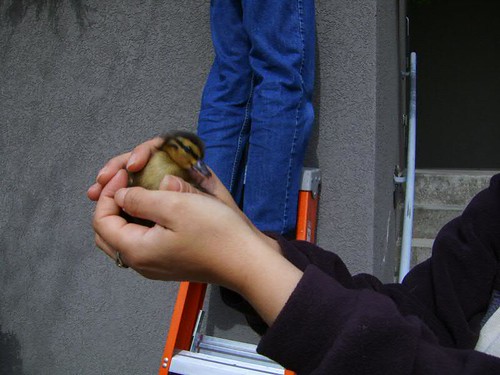
This year I dived back into the bushes and it was Dave's turn to stand and laugh (and also to stop me from breaking my neck after an ill-advised jump on the stairs). After the problems of past rescues this one went pretty smoothly.

First, the preliminaries: after four years of this ritual, mama duck no longer considers us a threat, and when it's time for the babies to leave their impossible nest she actually comes to the front door of the office and quacks. Then she takes an enormous, smelly dump on the steps (presumably because she's been holding it in during the last few days of intense nesting action).

This year, though, she retreated back to the nest by the time I got out there, and she absolutely REFUSED to let me near the babies. Maybe she realized that one of them wasn't ready to go yet. I made a few half-hearted attempts to approach her, only to have her hiss ominously, which is pretty spooky when you're wedged face to face with her among the gridlocked shrubbery.

Half an hour later she was back out and down on the lawn, quacking for her cheeping babies to come down. Time for us to get to work.

I've discovered a good technique for trapping ducklings in our work planter: I push myself deep into the torturous foliage, with my hands free to scoop the huddled birds out of their nesting corner, and with my left foot against the wall to block their escape. Any ducklings that got past me were ably trapped by workmate Mark, who participated for the first time and probably managed to totally destroy his office casual attire.

Our other innovation was a stiff recyclable grocery bag, which we could put on top of the bushes and drop ducklings into as we caught them. Previously we had to climb partway out of the planter and drop them one-by-one work workmate Aurora far below, which allowed the remaining ducklings to reassemble in a more remote spot and also resulted in more than one baby falling beak-over-tailfeathers into the flowers on the front lawn.

We got eleven of them out and the mother walked toward the creek with her entourage, but one poor duckling was unable to keep up; maybe he was a runt, or maybe he was damaged or deformed, but he seemed to have trouble walking quickly. It was absolutely HEARTBREAKING to watch that poor little baby trying EVERYTHING to catch the herd, occasionally falling helplessly on its back and peeping terribly.

Amidst the usual unhelpful and pointless comments from passing coworkers -- "Nature's cruel!" "Natural selection!" "Let them die!" -- I wondered whether I could adopt this bird. But I've got a cat who LOVES to eat cute little things, and you can't housebreak a duck, and I've got enough things to worry about in my life as it is. So instead I picked him up and helped him along whenever I could, and when he finally got into the water he seemed able to swim well enough to his mother, so maybe he'll live.

It's inevitable that every year a few ducks will hatch several hours later, requiring us to catch them and take them down to the creek until we find the mother. This year, though, it was just a single bird that hatched late...and the parents actually came back for it! I don't know what they'd done with the rest of the brood -- probably left it with an aunt or something -- but after we dropped the latecomer down the three of them waddled back to the water. This is the first time I've seen the mother come back, and the ONLY time I've EVER seen the deadbeat father get involved.

Maybe he's off the booze and is trying to make a second go at family life?

Wednesday, April 28, 2010

Jobs: WATFAC

In the summer of '90 I had an amazing opportunity that I mostly squandered: I spent a few months working at WATFAC, the Waterloo Foundation for the Advancement of Computing.

I got into this because my computer science teacher at the time (Savio Wong) recommended me for their yearly student work program, which required some level of aptitude for computer programming. Not knowing C I was at a bit of a disadvantage, but I WAS a little BASIC wiz and I had some experience with dBase III, which would turn out to be the big asset.

What they wanted us students to do was to learn how to use the new software they were developing: Application Creation Made Easy (ACME). It was -- for the time -- an amazing package that integrated with their WATCOM SQL engine and a specially built "Foundation" library, and was supposed to do exactly what it said: make it easy for companies to create applications, particularly the types that were front ends for data storage.

Basically, you built a database using WATCOM SQL, and then you went into ACME to add a user interface for it. This interface was -- strangely and perhaps fatally -- built in a spreadsheet, where each cel represented a page. It was up to you -- the application developer -- to place fields for displaying and entering data, and buttons that the user could press, and write the behind-the-scenes code that controlled the flow throughout the program.

The first thing *I* did with it was create an interactive adventure that allowed the player to explore the WATFAC building, because it was a very strange place to work. Formerly located on the corner of University and Phillip (where "The Marble Slab Creamery" is now), it was a refurbished bank, complete with a vault in the basement where we ate our lunch. The whole place was a rigged-up nightmare of tiny rooms and running cables.

In addition we were occasionally overseen by Wes Graham, patron saint of Waterloo computing, wonderful and just a tad eccentric. During his bizarre orientation speech he used an "onion" metaphor to describe the way layers of information are peeled back, but then he got frustrated when he realized that onions don't have the cores that his metaphor demanded. This lead to us lowly co-ops -- so often with free time on our hands -- creating a grand mythology: Wes didn't want to "advance computing," that was just a front for his REAL project: the sinister development of a peach/onion hybrid called "The Ponion."

All of the games, drawings, and stories we made were based around the Ponion mythology. This was better than what the co-op University students were doing: playing battlechess across the local area network. WE never got caught (because our fun and games were created with company tools and looked like work) but when THEY got caught there was absolute hell to pay (and a memorable lecture to the whole group about teamwork and work ethic).

My problem was that I'd been placed in the only large room in WATFAC, a conference area that I called "the circus." This room hosted about twenty computers and was where all the nerdiest computer students were...and me. These guys were hardcore, they smelled a bit, they had loud voices and yawking laughs; the archetypal computer nerds. Since I was several years younger and I DID NOT KNOW C, there were frequent attempts to denigrate me, and equally frequent attempts by me to explain to them that they should try to straighten out their hygiene and their social problems, and never any work getting done because they were all yelling about the jokes in the latest Math newsletter.

Anyway, our REAL purpose at the company was twofold: to be beta testers for the ACME software, and to write full-fledged applications using it that could be demonstrated to local companies like Bell Telephone and the Waterloo Public Library. We were each randomly assigned an application that a company had shown interest in, and unfortunately I got the one I was least passionate about: a tracking program for expense accounts, under the watchful eyes of a local insurance company. It also had the worst name of them all; while others got names such as "InfoBook" and "InfoList," mine was "InfoExp." Difficult to say, even more difficult to enjoy doing.

What I remember most about this process was the attention given to the user experience, particularly in relation to hotkeys. There were few standardized hotkeys back then -- F1 for help was the only function key that had any real meaning across programs -- and the management quickly saw the necessity of standardization. So everybody brainstormed and came up with hard-and-fast rules for what each function key would do in every "Info" program, and we stuck to it.

Another thing I remember about the user experience was trying to organize data onscreen in a way that was friendly AND informative. While the other kids in "the circus" were outperforming each other trying to hack the ACME boot program with C in order to add esoteric and impossible-to-maintain features, I introduced my one innovation: ASCII graphics to create boxes around lists and to separate data from instruction. Simple and effective, but nobody had thought of it before. Within days everybody had a sheet of ASCII codes at their desks.

At the end of it all we had to give presentations of our programs to the companies themselves. I think I've blocked my presentation from memory -- not bad, but not great either -- but I DO remember the presentation that Mike gave.

Mike was the most obnoxious co-op there -- every day he'd make an endless string of bad computer jokes, along the lines of "Database engine won't start? Pour some gas in it! Hyuk hyuk hyuk! Right into the floppy drive! Hyuk hyuk!" -- and his application was for book filing and reference. He used to brag about how fantastic his presentation would be, and when he stood up there in front of the Waterloo Public Library board I saw an obnoxious, pushy braggart become a confused and stuttering fool. Plus all the books in his sample database were by Gary Gygax. Fail.

Eventually the job was over. I got a nice paycheck, a nice evaluation, and a nice reference, plus a free copy of ACME that I used as supplementary income (by creating a locker assignment application for our highschool).

What I remember most, however, is something I haven't even touched on: it was the first time I lived away from home. The parents of my friend Jeff -- who was also in the program -- owned student housing in the university ghetto, and they allowed Jeff and I to stay in an empty house while they renovated it. I remember many evenings mowing the lawn and painting the railings.

Looking back, it seems to me that I enjoyed this "moving out" experiment very much. My parents would drop in occasionally, and I spent some time wandering around the city and hanging out with Waterloo friends. This was when some women had been sexually attacked on the university campus, and I remember little groups of calm vigilantes wandering around campus and checking student IDs.

I also remember the first time I learned not to leave a kettle boiling when you leave for work. I remember playing Dragon Spirit obsessively at Flynn's arcade during lunch hour -- just to escape the airless, windowless lunch-vault -- and also that my Kate Bush obsession had reached its peak: my paychecks were going to vinyl bootlegs from Encore Records, and I picked up my first Peter Gabriel album (III) when I learned that Bush had done vocals for it. My mind was blown.

Now WATFAC is gone, and WATCOM is only really remembered for their compiler (though children of The ICON will remember WATCOM BASIC). Looking back, I think that ACME failed because it was released around the same time as Visual BASIC, and while ACME was more powerful it was also much harder to use. I'd love to see the program again someday.

And Wes Graham? When I went to the University of Waterloo many years later I was thrilled to see him as a "special guest" in a FASS show, playing a janitor. Everybody cheered. Now there is a road named after him.

Bless you, Wes, and your elusive Ponion.

Sunday, March 21, 2010

Career Counselor

After working a variety of jobs and majoring in a degree that I belatedly decided I didn't like, I feel I've finally found the perfect career: technical writer. It has just the right levels of independence, innovation, creativity, and variety.

But that doesn't mean I'm not open to other possibilities! While taking a break from animation (!) and with a cat permanently embedded on my lap, I decided to try..."Career Counselor" by Melvyn Lebowitz.


How can you not trust your future to a 1982 program written in BASIC for an 8-bit computer? Regarding the animated title screen, you'll note that the little pink woman in the dress goes to work in an office building after leaving school, while the naked blue man (presumably cold) works in a factory. He's also waving "Goodbye forever, until my job goes overseas!"

Anyway, which jobs did "Career Counselor" pick for me?
  • EDITOR
  • HISTORIAN
  • HORTICULTURIST
  • POLITICAL SCIENTIST
  • PROSE WRITER
  • SOIL CONSERVATIONIST
  • TECHNICAL WRITER
Besides its insistence that I spend more of my time with plants, the suggestions are surprisingly good, though apparently I'm overpaid because the TECHNICAL WRITER's earning level is "24,000-29,999." This is notably higher than the earning level of either the PROSE WRITER or the SOIL CONSERVATIONIST, though the former's employment outlook is strangely "Good-Excellent." I guess things were different in 1982.

Maybe, as a hobby, I will start conserving soil.

Saturday, January 02, 2010

A Plane in Every Driveway


Either folks in the early '30s were positively airplane crazy, or the companies that built airplanes wanted to manufacture that impression. Issues of The New Yorker have contained airplane advertisements from the late '20s, but by March 15, 1930, the trickle of plane promotion has become a flood.

Half of the advertisements are devoted to commercial flights, either for vacationers ("Havana") or commuters ("New York to Boston"). The commuter flights were surprisingly cheap ($11 or so) and seemed to involve some level of comfort: in-flight food, heated cabin, the works.

The advertisements for PRIVATE airplanes are far more interesting. It seems you could buy a plane for about $1000, and by folding up the wings you could keep it in an ordinary car garage. The implication, by 1930, really was that you could store and use a plane enough to make the price worthwhile...though they're a bit vague about what you'd actually use the plane FOR. And they tend not to mention picky things like "runways" and "engine maintenance" and "maximum load."

I'm looking at an advertisement for a personal open cockpit biplane from the Travel Air Company. It's the story of a man whose wife -- after landing the plane "on the lower lawn" -- finally talks her father-in-law into "going up." He has the time of his life and is an instant convert to private air travel...but he never says "Wait a minute...what do you guys use this thing for?"

And that IS the question. Why don't we each have an airplane in the garage? I suppose because few of us have "lower lawns" to use as runways, and neither do our workplaces. Maybe most of us are afraid of heights. Or maybe air congestion would be too difficult a problem to solve. Or -- most likely -- the growing passenger capacity of commercial air travel made private planes less essential to most of those who would have bought them.

Today I only know one person with a pilot's license. I'll have to ask him what he plans to use it for. I hope he'll have some insight into the practicality of air travel.

PS: In the same issue of the magazine, the London correspondent laments the sorry state of air travel in England. Apparently the problem was that the airplane insurance was so high that each year's payment equalled the cost of the plane itself.

Wednesday, April 08, 2009

Mini Drag Show: "A Drag Queen and Her Seal"

Last week I realized that I'd temporarily lost my grip on my own destiny. I felt no sense of purpose and didn't know what to do. After a few days of moping around and staring out the window, I settled in and created this: an epic video starring Schnapps the Seal.


I think it stands pretty well on its own, but here's the whole background, if you're interested.

What Came Before

Last month I was tapped by my company to help create a "demo reel" for one of our products. I was given a script to read, and in addition I was asked to create the music to accompany the demo. It was a challenge I threw myself into.

I figured this would be a good chance to explore Logic Studio's huge collection of Apple Loops, and I discovered that they ARE useful. It still takes a lot of skill to mix and match the loops, but that's only the beginning...if you really want the project to sound good you need to do extensive editing of the loops themselves.

The result was a darn fine demo reel, and a song called "Buy Our Sexy G-7." My company has complete ownership of the reel so I can't post the material independently, but once they post it online I'll provide a sneaky link to it.

"A Drag Queen and Her Seal"

I scribbled down some simple dialog last Thursday, with a few basic ideas but no actual storyboards. I've realized that I HATE doing storyboards. In addition I wanted this project to be totally free of copyright infringement...all me, including the music.

Friday night -- before heading out to Club Abstract -- I spent an hour recording all the footage. It was incredibly hectic. I realized how hard it is to say lines to an impersonal plate of cotton balls, especially when you're a piss-poor actor. I switched a few things around at the last minute. I forgot to record one punchline entirely. I got awfully tired of having a seal puppet on my arm.

Editing

Really, iMovie is not such a terrible (free) movie editor, if you're willing to work in an entirely linear way (with no overlaps). I felt restricted by the choice of titles and transitions, but it's not like the rest of the video was particularly spiffy. Most annoying was the terrible hiss picked up by my Cannon SD1000 "Power Shot" camera...it's apparently due to kamikaze electrons, but I just chalk it up to "cheap internal microphone."

During editing I realized how much I'd benefit from having a second person around during the filming. I pronounced Schnapps' name differently at the beginning and the end, and my "clever" substitution of a vodka bottle for a Moscow Pride weapon (as opposed to a flip-flop, the original choice), made it look like *I* had bludgeoned Schnapps in the preceding scene. Oh well, ambiguity and mysteries!

Denoising

The hiss on the audio was really terrible. Once I'd "picture-locked" the edit I exported the audio and played with it in Logic Studio, but none of the plug-ins made a noticeable difference.

Then I discovered a denoising tutorial for Soundtrack Pro -- a utility which comes with Logic Studio -- explaining how to take a "noise pattern" snippet from your audio and use it to cancel the noise in the rest of your clip. I'd never used Soundtrack Pro before -- and I can't see myself using it for anything but this, particularly because its shortcut keys are totally different from Logic -- but its noise cancellation thingy did a pretty good job. There's still some hiss in the video but it isn't quite so bad.

Music

So I exported the denoised audio from Soundtrack Pro and brought it into Logic Studio, along with the video clip, and I got to work on the music.

One problem with not having a professional video editing system -- or a bunch of people all working on the video together -- is that it's difficult to cue music to video AFTER it's been cut, especially when you're a non-musician working with a strict temp. Sometimes a video transition happens in the middle of a bar.

But that isn't really important, because I've realized -- both in this project and the demo reel project -- that soundtrack music is both subliminal and terribly important. You're not supposed to notice it -- though this "Schnapps" video is deliberately campy in that way -- but if it's not there then everything is flat and boring.

Anyway, about the loops and sound effects. Soundtrack Pro comes with two gigs of foley-type effects that I thought I'd never use...but just like the Apple loops, I've discovered how useful they are for quick and dirty (and low-expectation) projects. Want a crowd noise? Grab from the two dozen ones available on the DVD! They even have a collection of screams that are lots of fun and quite distinctive.

Since I was doing this video project for myself -- and was therefore unconcerned with an even remotely professional result -- I finally decided it was "good enough," even if it sounds a bit thin and unfinished (particularly near the end). Still, I think it worked out pretty well, and I'm amazed that an hour of filming and approximately ten hours of post-production have yielded a nifty little video.

Most important are the lessons I've learned. There's nothing like an enforced project to force you to learn your applications better. I'm ready for the NEXT video...but what will it be?

Wednesday, December 24, 2008

Merry Christmas!

There is an evil air which surrounds the holidays. A partridge, exposed to it, would die.

My day is finished, I am rushing under a weight of dark clouds and snow. There isn't enough work to do now and I find it painfully difficult to pass the time. The questions I ask go unanswered because the world is losing its people; only the old and sick are left behind to mingle with the busy, and none of them have time to gather together. They've closed the doors to their homes and offices. They have no plans.

My own plans have changed to include foresight; I must find my way home, I must eat, I must wake up again tomorrow. In my dreams I see a wind-blurred deadline which refuses to be observed, but just as stubbornly refuses to be moved. When it arrives it will catch me standing there, exhausted, mouth hanging open. It will knock the tree over.

At home I can't bear to do the cleaning. Instead I stand at the glass and watch hills around me blow apart and become smoking-white planes. This vacation is a time for losing things: a friendship, a soul, a pair of beautifully-knitted mittens. These things are replaced by a freeze which comes through the bottom and sides of the kitchen door.

There is an evil air to the holidays, a pressure, a losing. I'll say something nice to the mailman when he comes back.

Monday, October 20, 2008

Fighting the Sound Board

It's been a year since I last had the Sound Board Nightmare, but it returned last night.

In the Sound Board Nightmare I am in charge of engineering a live radio show. Things go well at first, but halfway through the currently-playing song I am unable to find a follow-up promo. I look everywhere. Nobody will help me. The final seconds of the song tick away and I quickly hit "Play" to play the next song as a substitute...but instead the song plays again, a second time.

Everybody stares at me. Something breaks down. I can't find the sheets that tell me when to play commercials. I panic, surrounded by staring eyes and dead air.

I stopped having these dreams when I stopped DJ'ing, both live shows and at CKMS. Since the demise of CKMS I have had little urge to get involved with radio again, especially not at a station that is hanging by such a tiny thread.

But there's ANOTHER community station in town, and it just so happens that a friend of mine his resigning his position, and he was looking for a replacement...

...so now I'm the Technical Director of "Monday Night with the Arts" on CKWR. I have a ton of sound mixing experience, but this is stretching my skill set a bit: a heavily scripted program, several guests on three different microphones, phone-in interviews...it's a real step up. Once I get the hang of the equipment -- and figure out how the darn Cue works -- I'm sure it will become second nature, but for now I'll suffer the Sound Board Nightmares.

Tonight was my first night, and coupled with a crippling insulin reaction I was a bit of a wreck. Fortunately the outgoing Technical Director was there to guide me, and the show didn't turn out too badly.

Besides keeping my skills polished and having something interesting to do on Monday nights, this is also an opportunity to keep up with the local Arts community...and it IS nice to be part of a radio station again...especially one so TIDY!

Saturday, July 12, 2008

Embarrassing Moments: The Precocious Teen


In the late '90s, the video store I worked at moved to a new location and the stock was distributed differently throughout the store.

One night a teenage boy came into the store and started looking around.

"This place has changed since I used to come here!" he said.

"Yes, everything's been moved."

The boy walked around a corner and came back. "The Russ Meyer section is with the other sexploitation films now."

"Well...it was always with those films, only now they're labeled."

"No, those sections were always apart! I know because I used to come here all the time!"

"I WORKED here, and I'm telling you that they were always together."

The boy huffed and walked to another section of the store, then came back to the counter again. "I notice you finally got the Nick Kern videos."

"We've had them for years."

"No you didn't! You didn't have them last year!"

"We DID have them last year."

"I've been coming here for YEARS and I've NEVER SEEN THEM."

This kid was obviously worked up about something so I stopped arguing and let him spout his incorrect factoids, which he continued to do for another half hour.

The next night I came to work and told my boss the story. "You should have seen this kid! He was such a freak! Kept on babbling about how he used to come to the store, as if anybody cared, and insisting on describing 'how the store used to be'...and getting it wrong every time! It was embarassing to listen to him, he was such a brat, you would have loved making fun of him."

Suddenly, out of a crowd of people who were standing near the counter, the boy pushed his way forward. "THAT WAS ME!" he yelled, then ran away.

We stood there, stunned. The boy's mother came to the counter and said "He's been in the hospital for a while, he's clinically depressed. He always loved this store because he said that people here respected him and took him seriously. This was the first place he wanted to visit when he came home."

I felt terrible. The boy came back and started crying, yelling at me while the mother stood in the background. I pulled a rationalization out of my butt.

"We make fun of EVERYBODY here," I said. "Are you telling me you've never heard us make fun of customers before? That's what we DO. If we didn't care about a person, we'd never talk about them. Seriously."

This was partially true -- we DID always make fun of customers -- but we genuinely disliked the people we mocked. Fortunately the kid was so desperate that he grasped my rationale. By the end of the night he was happy again. Whew.

I learned a crucial lesson that I try to apply every day (and should apply more often in this blog): don't mock people in public places, and try to remember that annoying people are sometimes covering up a deep fragility. You must not drive them to suicide in front of their mothers.

Thursday, July 03, 2008

The Spot-Hole

Today I'm in the bathroom at work and I'm staring at the wall -- for reasons you can guess -- and I notice a little point of light.

So I look closer at it and it appears to be a small hole in the bathroom wall, about a millimeter in diameter, but when I move my head a bit the light disappears.

To make sure it isn't just a shiny fleck of paint I cup my hands around the spot...and it continues to glow. It's a bright speck buried in the darkness of my hands. It really does look like a hole.

Workmate Charles wanders over to find out why I'm lurking around the toiletries and I show him the spot, and he cups his hands around it and says "Yeah, I think it's a hole," though he also notices the way it seems to reflect a bit, as though a flake of paint were covering it slightly. Another workmate -- Matthew -- sees us acting all suspicious and so he looks too and he confirms...yes, could be a small hole, very strange.

A hole in the bathroom wall.

I leave and get a pencil from my cubicle and come back to confirm the theory; I want to poke the spot and see if the pencil goes in. I walk up to the wall...

...and I can't find the spot. I search around and around. I cup my hands and look all over. The situation is complicated by the style of the paint, which is deliberately bumpy. I call Charles back and we look together and neither of us can see anything. Meanwhile the automatic toiletries are flushing like crazy because we keep standing in front of them.

By now we have collected a small bathroom mob. Workmate Don turns off the light while I stand in front of the wall, but I can't see anything. We ascertain out where the hole should exit -- an unused, dimly-lit storage area behind the elevator -- and we search that wall as well...nothing. Just in case there WAS a fleck of paint slightly covering the hole, I get a wet paper towel and start wiping at the wall, hoping to dislodge it. Nothing.

We sit around and stare at each other. Either the little hole got covered up somehow, or it was a remarkably reflective piece of material that fell off, or we just forgot where exactly we'd been looking.

It is an unsolved mystery. Like a UFO. In the bathroom.

Monday, May 19, 2008

The Great Duckling Rescue of 2008

Every year a stupid duck decides to lay her eggs outside my workplace. This would be fine if she weren't laying them in a ten-foot-high concrete planter that the ducklings can't climb out of; safe from predators, yes, but a deathtrap for tiny things that have yet to learn to fly.

In the past, many of the ducklings have either died in the planter or managed to escape only after the mother had given up, becoming dinner for local crows and cats. Their pitiful peeping cries were a terrible thing to hear. I couldn't stand it anymore.

So 2007 saw the inauguration of the first annual Great Duckling Rescue.

The problem with the GDR is that the planter is full of thick evergreen shrubs that have been growing for eight years; now they're an impenetrable, spiky mess. Under this the ducklings run hither and yon while myself and a brave volunteer get sliced to bits by evergreen thorns, trying to simultaneously hold the rigid stems away from the ground and catch tiny little things that run away at 30kph. In 2007 we also dealt with a dive-bombing mama duck, though this year she stood politely aside while we did our rescue operation.

The Dumbest Duck in the World

Apparently we saved fifteen ducklings this year. Before you say "wow, that's a lot of eggs!" let me point out that two more babies died instantly upon hatching, and another two eggs just never hatched at all (I guess my cubicle wasn't a very good incubator).

Some of my fellow employees think I'm crazy; their objections range from "survival of the fittest" (are we preserving a "stupid nesting behaviour gene" in the duck population?) to "nature is cruel" (yes, I know). Sorry, I can't just sit there and listen to animals die.

The day wasn't all downy sweetness, however; when I first climbed into the planter I think I stepped on a slow duckling and broke its neck. It was alive for far too long as we rescued its brothers and sisters...I won't go into details because it was pretty awful. But the rest of the birds seemed pretty happy, and when the mother walked away she was literally floating on a hovercraft of little bustling animals.

How she's going to PROVIDE for that brood is another matter.

Ducks Alive!

Wednesday, April 02, 2008

Type

I've just finished watching "Helvetica," the 2007 documentary about the English-speaking world's most ubiquitous, anonymous, and versatile font.

I'm not a very visual person and my knowledge of fonts is very much a patchwork, but there's no doubt that Helvetica is everywhere and that it's used to convey pretty much everything. Unlike almost every other font, designers can present it as impersonally cautionary (warning signs), cooly hip (British electronica band logos), or clean and upscale ("The Gap").

Today, while waiting for my optometrist to see me, I leafed through Vogue magazine and -- yes -- there was Helvetica, representing everything from shoes to jewelry to makeup. Since I find subconscious standards to be sort of ominous, I'm disturbed to report that I pretty much use it every day in my work: our technical writing department's style guide dictates Arial as the choice for headings and footers, and Arial is Helvetica's uneasy twin sister.

All this has gotten me thinking more about fonts in general, and how we tend to not even notice them unless something has gone wrong. People who design fonts share a sad fate with those who arrange film scores: their work is meant to enhance a final product without ever calling attention to itself.

Even though I've spent eight years working closely with fonts I can only recognize a handful. I've spent all this time working for a company that makes character generation software, and in all three of the jobs I've had during that time (technical support, quality assurance, and now technical writing) I've had to be aware of what a computer-generated font achieves.

Back when I was in the technical support department, I used to get calls from people who simply didn't understand fonts. They thought it was a "bug" if the ugly, outrageous, highly-specialized font they wanted to use -- Loki Cola for example -- didn't contain all the numbers and symbols that they needed for their video. They seemed to believe that fonts were generated by some sort of computer magic, instead of being designed by someone purely for the purpose of giving more tasteless options to cut-rate wedding videographers.

Once those people found out that fonts actually COST MONEY they got REALLY upset.

So I promise myself that now, after so many years of taking fonts (and fontographers) for granted, I'm going to learn a bit more about them. And, hopefully, I'll learn to use them more thoughtfully and effectively.

Monday, March 17, 2008

The Last 24 Hours

No I'm not being stylistic, I just can't bring myself to write this in "prose" (which requires some sense of meaning, direction, and endings).

* Greyhound bus terminal, standing in the cold, wondering why bus drivers only arrive at the last minute. This route to Toronto is the "molasses" run, which stops at all of Guelph's most picturesque locations along the way. The 130-minute trip should give me lots of time to find an iPod soundtrack but for some reason I can't choose one.

* I have decided at the last minute to bring Thomas Pynchon's novel "Mason & Dixon" with me, because I am so involved with it that I can't picture myself reading anything else. But it weighs at least ten pounds and is huge and unwieldy, and difficult to concentrate on when the guy in the seat behind you is talking about his favourite "keggers." "Dude, Cathy was GREEN, man. I mean GREEN. What? Like, she was SICK, man, Cathy was GREEN."

* At the Toronto Bay Street terminal I pile up all my luggage and begin the trip to Chez J&C. It is very cold, Sunday afternoon, downtown Toronto relatively unpopulated. In the lobby of J&C's apartment, two parents are trying to wrangle a stroller, an infant, and a toddler into the elevator, meanwhile retrieving the mitten that a man had dropped while exiting. Their hands full and their baby-equipment blocking access to all but the smallest person, they send the toddler in to find the mitten, which he is unable to do. The doors keep closing, the parents lunging in to knock the doors open again, the man with one mitten stands with me and we watch the show.

* Jason greets me and we begin the relatively mechanical process of getting into drag. Fortunately the Chez has two bathrooms. Both have been newly renovated in honour of the night, and the hard-working renovator -- Craig -- soon joins us to mix the cocktails. Craig doesn't fool around with cocktails. When Craig makes a cocktail, it is "a glass of vodka with a shot of Diet Pepsi." This explains why, when we leave the apartment, I tell the cab driver to take us to "Queen on Play."

* At Play on Queen -- the venue for the night -- I make myself comfortable in the change room and re-meet both Teran Blake and Fahrenheit. Not only do I not instantly recognize Fahrenheit, but I happily tell her that she "made fun of me once," failing to provide context or explain that I wasn't lodging a complaint with her. This is why my Facebook "agreeableness" score is at 25%. Setting up a sort of Marx Brothers situation, the bar staff begin to pile tables and chairs within the change room. Soon the room contains two small islands, each with a mirror, tenuously connected by a narrow path. When the flock of hispanic queens arrive this becomes particularly surreal.

* Still coming out of a week of insecurity and general "off-ness," I perform two shoe-in numbers that I know I can ALWAYS do well: "Don't Tell Mama" and "Love and Truth." The response is good, as far as I can tell through the blazing spotlight, though the crowd is hardly demonstrative. I make the silly move of trying to pick up tips while wearing well-worn gloves, which results in a spray of coins on stage. Craig cheerfully documents this with his video camera.

* As a whole, we raise a substantial amount of money for the TICOT charities. This is a good feeling indeed. My blood sugar has remained PERFECT all night. Plus, through some accident, I get not one but TWO free drinks. My good feeling knows no bounds.

* After the wonderfully-brief show I begin to understand the bar dynamic a bit more: at 11pm the TICOT performers are followed by a regular show put on by 10,000-volt hispanic queens, a subculture notorious for its crowd loyalty. While watching their show I have my second great bar-stranger conversation of the night, followed finally -- on the way out -- with a nice chat with Michelle DuBarry, who recommends that I improve my diet.

* Back at Chez J&C we review the night's documentary evidence, and Jason informs me that I do a trademarked maneuver with my bum but I'm not sure yet exactly what that is yet. Pizza at 1am. The John Barrowman Experience. A tranquil sleep only once interrupted by the garbage man.

* 8:30am, I assess the situation; Jason has gone to work and Craig is still asleep. I suffer typical morning restlessness and decide I should at least transport my luggage to the Greyhound station, leaving all future possibilities open. As usual when I visit J&C, I exit the apartment with more things than I came with. It's like magic!

* Another cold walk with lots of luggage. A suitcase full of feathers is surprisingly heavy. At the bus station I realize the only "good" breakfast option is an eggs & bacon thing at "Kramden's Kitchen," which I'm sure Michelle DuBarry would berate me for. Nevertheless it is good. My bus will not arrive for ninety minutes.

* I sit and read "Mason & Dixon." This book, along with the constant lifting and pulling of my luggage, is turning my hand into a burning witch's claw. The old lady beside me is very angry about the pigeons, which appear to spend their entire lives inside the terminal. Pigeons are very individualistic. They make coordinated "sweeps" periodically across the floor, and though they look intelligent they keep pecking away at the same specks of indigestible dirt.

* I decide to find a bathroom so I can get some paper towels to wipe my nose with. I take the elevator down to the terminal basement and discover that the bathroom there is a "closed for cleaning." A sign directs me to use the bathrooms in the adjacent Ainsley terminal. I take the elevator back up and pull my luggage across to Ainsley -- which is always deserted, disgusting, and post-apocalyptic -- and discover that the bathrooms there can only be reached by going downstairs. I will not carry my luggage down and then up again. My hand would not survive. Instead, my nose must drip.

* My iPod soundtrack is easier to choose for the ride home: The Fall's "Infotainment Scan." The bus takes a strange and unexplained detour through Mississauga via the mostly-vacant toll roads. The outskirts of Mississauga are surrounded by lakes, barely frozen with patches of rotten ice. These lakes are everywhere and they do not look natural or healthy. Trees are buried within them, their branches poking out. Beyond the lakes, the biggest and most generic suburb of semi-detached houses I have ever seen. I suspect that the lakes are just house foundations waiting to sprout.

* As always when I drive past the Niagara escarpment, I wonder what that huge gouge in the rock is, which you can see going west on the 401 past Halton Hills. Some sort of footpath appears to cross the vast canyon, but it's so far away that you can't see what's really happening. I vow that when I get a car I will investigate this.

* Home. A feeling of goodness, both from the going away and the coming back. My hand will ache for days, burning while I work. The cat is aloof at first, punishing me for leaving her alone for the night, but soon she has come around and we are watching "Constantine." Even she dislikes Keanu Reeves, but she's too polite to complain.

Saturday, March 15, 2008

How to Stop a Habit

I'm no stranger to semi-voluntary habits. As a child I was such a bundle of twitches, shakes, and clenchings that it's a wonder they ever got a clear school picture of me.

My tendency to twitch is entirely related to stress. In periods of relative calm I find that I never twitch at all, but when I have a lot of things on my mind I begin to give occasional shakes and twitches, and when I'm in that state and I start to do something that REALLY stresses me out -- like write a letter about squirrels to my landlord, or prepare to go on stage at a drag show, or come up with a blog entry -- I begin to jitter like an electrified tumbleweed.

I usually find myself twitching a part of my face, and this is the most involuntary of the habits. I'm good at making sure that I don't do this where anybody can see, but I'm still convinced that it gives me wrinkles, and I don't need any help when it comes to THAT.

If I can stop the facial twitches they usually move into my hands. I had hand spasms throughout my entire five years of working at Tim Horton's, and I used to mentally berate myself, thinking it was terribly obvious to everybody I worked with. It probably wasn't.

When hand spasms don't do the trick I sometimes clench my stomach, which leads to general abdominal problems. Stomach-clenching was my habit of choice as a child, and I like to think it causes more permanent damage than all of the other habits combined.

Finally -- and this is one that I've only noticed in the last five years or so -- I tend to tightly clench my toes, usually while sitting at a computer or while taking a bath. This didn't seem to be a problem in my old apartment, where everything was carpeted, but now it seems to be having a negative impact on my joints...or maybe I just have rheumatism. If it persists I'll need to see a doctor.

Anyway, I've found a way to stop these habits, and I'm sharing it with you. "They" say that habit-stopping must involve the transference of "bad" habits into a similarly stress-relieving "good" habit -- like squeezing a stress ball for example -- but I've found that I can just stop ALL the habits with this simple method:

At work -- where most of the twitching occurs, probably because I'm stuck in one spot where I can do all the face, hand, stomach, and toe-clenching that I desire -- I write "Twitch" on a post-it note and stick it to my monitor.

Each morning I write today's date, and every time I clench-up -- even the slightest bit -- I draw a tick-mark under that date. When I go out for lunch I count up an estimated number of clenches and add them when I get back to my desk. Clenches which occur at home are not counted.

The very act of acknowledging the sheer number of habits per day is enough shameful mental reinforcement to eliminate the tics and clenches. The first day always has the most clenches -- somewhere in the area of 30 usually -- and then all subsequent days show a decline. After two weeks the clenches number only one or two per day, and even those are so minor that they may have been reflexive as opposed to actual habits.

I leave the post-it note affixed to my monitor, but I remain habit-free for weeks, if not months, until the next big wave of stress arrives.

This may not work for you -- I think its effectiveness involves the amount of personal shame you can heap onto yourself without feeling overwhelmed -- but it has certainly been effective for me. I am, after all, a bottomless reservoir of shame!

And hey, if you feel like sharing your own spasm-stories, please do! I'm always curious to hear how other people deal with such "secret problems."

Sunday, March 02, 2008

Playing the Game Episode 7: "Wolf"

Shameless, happy self-promotion! Episode seven of the WebTV series "Playing the Game" is now online...and I'm in it! See for yourself (it's not R-rated, but you probably shouldn't watch it at work):


(For a much higher-quality version go here to the official site).

I think this turned out very, very well; the story is lots of fun, the narration is suitably chirpy, and Mitch's camerawork -- one long shot, for most of the episode -- shows not just his own skill but also the amount of work we put into "getting it right." And kudos to Delirium Clothing for the "Freedom Turkey" outfit that I'm sporting!

Yes, believe me, we did this over and over again. The first few takes I recall as being particularly sedate, but as we went along things got more frantic; I think this is from one of the middle takes, before we lost control and I knocked over the bar.

Even though it's a "silent" film, Steve Hutton did in fact record our mostly-improvised lines "for a DVD extra." Yikes!

Wednesday, February 13, 2008

A Moment's Pause

Sometimes, when this blog goes silent for a day or two, it's because I'm stupid and brain dead and I just want to take a seventy-two hour nap.

But at other times -- like this -- it's because I'm working on so many things that I simply don't have the time or brainpower left to explore heavy blog topics (such as the potential fetish appeal of 1920s cruise-line fruit).

What am I doing? I'm glad you asked! Besides the physical/mental logjam that occurs the week before any approaching drag show (it's tomorrow night!) I am also swamped at work (wading into the treacherous waters of DITA), continuously shoveling the sidewalk, finishing off a song that's been in the pipe for more than a year, experimenting with my new hair extensions, and...

...putting together a silly online project that I will link to in a day or two, but which will be of interest only to die-hard devotees of a certain obscure musical group. I mention this not to get you excited -- because I don't think anybody who reads this would be interested in the final product -- but only to explain why I'm so quiet right now.

PS: I'm also watching a DVD collection of pioneering films from the turn of the century, back before anybody realized that a camera could move (unless it was mounted on a train) or that chase scenes didn't HAVE to show every single participant arrive at one edge of the film, cross laboriously across the middle, and exit completely off the opposite edge.

Oh, those simple, child-like directors with their top hats and mustaches! Oh, those sickly-looking infants dressed in oversized doilies! Oh, those insatiable, oat-eating horses! And let's not forget the eight-year-old children working in factories to help buy heroin-laced medicines for their consumptive, coal-mining fathers.

It's no wonder they didn't have time to discover "the close-up."

Wednesday, February 06, 2008

Blasted Barmy Poozy

Somebody pooped on my workplace. Literally, he or she pooped on the SIDE of the building, two feet from the door that few people other than myself ever use.

Since Monday I have seen this poop twice each lunch hour, and it has done nothing for my appetite. I'm increasingly fascinated by its longevity: nobody seems to have noticed, and it is impervious to the weather, looking exactly the same now as it did three days ago.

This is a strange secret that I'm keeping, especially because the poop is right underneath my manager's window. I see her several times a day and I keep wanting to tell her about it, but I know she wouldn't appreciate the news. She'd either have to clean it up herself or just sit there by her window, thinking about it, the way I do.

Vanilla has never seen the poop but I keep her appraised. I pretend that it's Allison Goldfrapp's poop. I pretend that she'd call it her "blasted barmy poozy." This makes the situation more bearable.

Every night I wonder if it will go away, and every day I return to find it still there. There's nothing I can comfortably do about it. I can only see which one of us gives up first.