My "I'd Buy Anything" spree came to a temporary halt because I'd already mentioned Nits enough in this blog...was there anything else left to say?
Today I was listening to their latest album ("Doing the Dishes") and I realized that after thirty years of releasing albums, their music was still as fresh and wonderful as always...yet for all their fame in the rest of the world they've remained an isolated cult phenomenon in North America. What's up?
I really can't explain it. Many of their songs are 100% radio friendly. Henk Hofstede's Dutch accent is heavy but still totally decipherable. His lyrics tend to be a bit obscure and occasionally absurd, but apparently people don't care about lyrics anyway. So why does each Nits album contain half a dozen beautiful pop songs that only a handful of people on this continent will ever hear?
Since I can't answer that question, let's take a journey through their career. Here they are after releasing their first major-label album performing "Tent," back in their herky-jerky New Wave days. This was before keyboard virtuoso Robert Jan Stips joined and everything is in an almost frightening lockstep, but that was certainly a style they explored between 1979 and 1980.
Bassist/keyboard player Alex Roelofs left shortly afterward and was replaced by Stips, who added a sudden lushness to the arrangements: keyboards, keyboards, and more keyboards during an era when keyboards were kings. Here's 1984's "Mask," which suffers greatly from Jaap Eggermont's "Stars on 45"-style production techniques, but is still a wonderful little song.
In the beginning, both Henk Hofstede and Michel Peters shared the songwriting and singing duties, but eventually Peters left, and some would consider that a good thing; he tended to write haiku-like art-rock and his voice was a tad wheedly. Then along came bassist Joke Geraets and the four members struck a perfect balance of electronic rock, and this was also when Rob Kloet's drumming really came into its own.
Some would consider 1987 their career highpoint. It certainly spawned the only Nits single to make a dent in the North American charts: "In the Dutch Mountains" (turn up the volume for this one).
After Geraets left for medical reasons, the band experimented with orchestration and Philip Glass-style minimalism, then made a stab at the charts with a remarkably conventional album ("dA dA dA") in 1994. They'd also briefly added Martin Bakker and Peter Meuris to the mix. Here's one of the better songs from that period: "Homeless Boy."
Suddenly, Stips took Bakker and Meuris away so he could embark on a solo career, and us poor Nits fans were left wondering: could they continue? Hofstede and Kloet disappeared for a bit and came back with two of their best albums ever, recruiting new members Arwen Linnemann and Laetitia van Krieken for live and (eventually) studio work. I give you the lovely "Three Sisters" from the first of those albums, "Alankomaat."
But the next album -- "Wool" -- was a REAL shock. Jazzy, soulful, organic, and featuring backup vocals by Leona Phillipo, this remains my favourite Nits album yet. You can get the entire "Wool" concert on DVD, but here's a wonderful section: "The Wind, The Rain."
Robert Jan Stips just couldn't stay away. He eventually returned and it would seem that the other musicians became redundant, drifting away until only the core trio of Hofstede, Kloet, and Stips remained.
This hasn't stopped them from doing drastic reinterpretations of songs, however, often only a year or so after the original recordings. Here's a bombastic version of "Eifersucht" featuring full orchestra and Vera Van Der Poel, including a snippet of "Within You Without You."
Here they are today (well, last year) performing a stripped-down, almost "ragtime-folk" version of their latest single "No Man's Land."
If you aren't hooked on Nits by viewing these clips then you'll simply never enjoy them...and that's okay too! I don't understand why but to each their own.
Assuming you ARE hooked, the albums you should buy are "In The Dutch Mountains," their double-live "Urk," and "Wool." Their earlier works are a bit schizophrenic due to the Hofstede/Peters split, but the only albums you should REALLY avoid are their pretentious orchestral suite ("Hjuvi") and the Eggermont-massacred "Adieu Sweet Banhof." For fans only there are plenty of Stips side projects, and if you really love Kloet's drums, pick up his beautiful "Drumset with Dog."
Saturday, February 28, 2009

Thursday, February 26, 2009
Scattered Impressions of Injury and Recovery
I'm not an athlete and I don't take physical risks, but I've always had a disregard for the positioning and protection of my body. I might whine about painful shoes or a sore throat, but that only happens when I'm feeling self-absorbed or when the pain has become excruciating.
So it's galling -- but unsurprising -- that I've buggered up my right shoulder with a series of small injuries, boundary-testing, half-baked corrective techniques and general lack of concern. Over two months I progressed from an aching joint to acute tendon inflammation, atrophied muscles, and a possible cartilage tear. By gradually restricting the usage of my right arm to the half-dozen movements which don't cause me pain, I've managed to forget -- both mentally and physically -- how a healthy arm actually moves.
When I try to do certain everyday things with my right arm -- rotate my palm, put my hand over my stomach, reach to the right, or even THINK about putting it ANYWHERE behind my back -- I am met with either shooting pains or total weakness. The pain is bad but the weakness is just plain disconcerting...the muscles simple stop working. I begin to feel like I'm pushing my arm through a concrete wall, even though there's nothing visible in the way. I have, quite literally, withered my shoulder muscles.
An interesting thing about this injury is what it does to your sleep. I've gotten to the point where I finally CAN fall asleep without too much pain, but during the night my tendons strain and tense and bunch up, and by 3am I wake up in agony and have to do my exercises again. Then I sleep on the couch, whose shape keeps me in a position which doesn't hurt my arm too much.
The good news is that my ailment is relatively common and it is possible to fix it, but it takes a lot of time and work. I am amazed at the skill of my physiotherapist as she twists, shakes, and wobbles my skeleton and says "Aha, this is the exercise we'll do next." And after a week of exercising, that invisible concrete wall moves another few inches and I can bend my arm just a bit more.
Often I'm left standing at a machine with two handles at the sides, like an exercise bike for the arms. I have to pump away at it for ten minutes or so while staring at the single framed newspaper article hung on the wall, a story about a local boxer who benefited from physiotherapy. Each time I use this machine I pick one word from the article at random, and I read the article slowly until I find a word which starts with the same letter. Then I continue reading until I find another word which starts with the letter that the previous word ENDED with. I can do this three times before I'm ordered to use another machine, something more stimulating with pulleys and weights.
Sometimes a co-op student puts lubricant on my shoulder and rubs a small metal object over it, an ultrasound device which is incredibly painful when it somehow resonates the bone in my forearm. Once the physiotherapist wrapped a belt around her waist, then put my arm through the belt and rocked it back and forth as though she was comforting it. Unfortunately that caused my arm to freeze up in excruciating agony for several minutes -- a sensation I've previously described after slipping on ice or falling down while drunk -- so I don't think we'll do the belt thing again. When this "freeze up" happens it is followed by two days of dull ache in my bicep.
Usually, however, I leave physiotherapy with an extraordinary feeling of relaxed well-being. We always end with fifteen minutes of electroshock...well, they hook electrodes up to my shoulder and I gradually turn it up until my arm is jumping around like a fish in a bucket.
Today I made overtures to the Guelph hospital in order to get an MRI, since the therapist (and by extension me) is concerned that the cartilage in there is torn. Apparently it can take up to five months to secure an MRI so I have plenty of time to prepare myself for the giant needle they'll be sticking INTO my shoulder, though the figure-skating worker at the medical supply store told me that "there are ways to get in faster." She didn't tell me more...she just sold me six feet of rubber tubing for my daily exercises.
I also got an X-ray in a tiny, deserted, run-down clinic that appears to be run by a husband and wife comedy duo. I got undressed in a closet and then stood in a dark room in front of hundreds of pounds of equipment. The man put a rubber girdle on me and ran back and forth taking pictures, occasionally slipping them into a cupboard marked "Exposed." Terrible scrabbling sounds came out of this cupboard even though nobody was around. I turned to the left and came face-to-face with an enormous poster of a muskrat, the only decoration in the entire place.
The prognosis so far? Months of exercising, expensive physiotherapy appointments, and drinking WITHOUT falling down. In the meantime, frenetic drag shows at Club Renaissance are strictly verboten: quick-changes involving zippers between my shoulder blades and slipping dresses over my head are simply not going to happen. But I'll still be doing shows in Guelph near the end of March, since they're relatively sedate and I'm sure I can wrangle a dresser from the chilled-out organizers.
So it's galling -- but unsurprising -- that I've buggered up my right shoulder with a series of small injuries, boundary-testing, half-baked corrective techniques and general lack of concern. Over two months I progressed from an aching joint to acute tendon inflammation, atrophied muscles, and a possible cartilage tear. By gradually restricting the usage of my right arm to the half-dozen movements which don't cause me pain, I've managed to forget -- both mentally and physically -- how a healthy arm actually moves.
When I try to do certain everyday things with my right arm -- rotate my palm, put my hand over my stomach, reach to the right, or even THINK about putting it ANYWHERE behind my back -- I am met with either shooting pains or total weakness. The pain is bad but the weakness is just plain disconcerting...the muscles simple stop working. I begin to feel like I'm pushing my arm through a concrete wall, even though there's nothing visible in the way. I have, quite literally, withered my shoulder muscles.
An interesting thing about this injury is what it does to your sleep. I've gotten to the point where I finally CAN fall asleep without too much pain, but during the night my tendons strain and tense and bunch up, and by 3am I wake up in agony and have to do my exercises again. Then I sleep on the couch, whose shape keeps me in a position which doesn't hurt my arm too much.
The good news is that my ailment is relatively common and it is possible to fix it, but it takes a lot of time and work. I am amazed at the skill of my physiotherapist as she twists, shakes, and wobbles my skeleton and says "Aha, this is the exercise we'll do next." And after a week of exercising, that invisible concrete wall moves another few inches and I can bend my arm just a bit more.
Often I'm left standing at a machine with two handles at the sides, like an exercise bike for the arms. I have to pump away at it for ten minutes or so while staring at the single framed newspaper article hung on the wall, a story about a local boxer who benefited from physiotherapy. Each time I use this machine I pick one word from the article at random, and I read the article slowly until I find a word which starts with the same letter. Then I continue reading until I find another word which starts with the letter that the previous word ENDED with. I can do this three times before I'm ordered to use another machine, something more stimulating with pulleys and weights.
Sometimes a co-op student puts lubricant on my shoulder and rubs a small metal object over it, an ultrasound device which is incredibly painful when it somehow resonates the bone in my forearm. Once the physiotherapist wrapped a belt around her waist, then put my arm through the belt and rocked it back and forth as though she was comforting it. Unfortunately that caused my arm to freeze up in excruciating agony for several minutes -- a sensation I've previously described after slipping on ice or falling down while drunk -- so I don't think we'll do the belt thing again. When this "freeze up" happens it is followed by two days of dull ache in my bicep.
Usually, however, I leave physiotherapy with an extraordinary feeling of relaxed well-being. We always end with fifteen minutes of electroshock...well, they hook electrodes up to my shoulder and I gradually turn it up until my arm is jumping around like a fish in a bucket.
Today I made overtures to the Guelph hospital in order to get an MRI, since the therapist (and by extension me) is concerned that the cartilage in there is torn. Apparently it can take up to five months to secure an MRI so I have plenty of time to prepare myself for the giant needle they'll be sticking INTO my shoulder, though the figure-skating worker at the medical supply store told me that "there are ways to get in faster." She didn't tell me more...she just sold me six feet of rubber tubing for my daily exercises.
I also got an X-ray in a tiny, deserted, run-down clinic that appears to be run by a husband and wife comedy duo. I got undressed in a closet and then stood in a dark room in front of hundreds of pounds of equipment. The man put a rubber girdle on me and ran back and forth taking pictures, occasionally slipping them into a cupboard marked "Exposed." Terrible scrabbling sounds came out of this cupboard even though nobody was around. I turned to the left and came face-to-face with an enormous poster of a muskrat, the only decoration in the entire place.
The prognosis so far? Months of exercising, expensive physiotherapy appointments, and drinking WITHOUT falling down. In the meantime, frenetic drag shows at Club Renaissance are strictly verboten: quick-changes involving zippers between my shoulder blades and slipping dresses over my head are simply not going to happen. But I'll still be doing shows in Guelph near the end of March, since they're relatively sedate and I'm sure I can wrangle a dresser from the chilled-out organizers.
Wednesday, February 25, 2009
The Doomed Ticker Party

Seeing these happy, upscale New Yorkers playing "Ticker: The Wall Street Game" in the middle of 1929 rings my irony warning-bells, and also makes me a little bit sad.
Scrutable Poetry Corner: "Il Penseroso"
Ahh, beauty in the May 18, 1929 New Yorker.
As for this poem it is credited only to "Bunny," but her real name was supposedly Eleanor W. Koehler. You may well ask "Who's that?" I haven't got a clue, but any bunny is a good bunny.
Sad weird figures garbed in white,"Antoine de Paris" -- originally Antek Cierplikowski -- was one of the more famous upscale hairstylists in 1920's New York. He claimed to have invented the shingle bob hairstyle, and therefore became the first of a long line of "celebrity stylists." Hairboutique.com has an interesting writeup about him here.
With their headgears tall and fearful,
Faces drawn--druidic sight,
Seated dumb--not gay, not tearful.
How they scan unconscious mortals,
As they come and go again,
Crossing through forbidden portals.
Are they happy or in pain?
Do they plan the fate of nations,
Gathered round, this mystic seven--
Good or evil machinations?
Do they think of hell or heaven?
Do they ponder living? Dying?
Pestilence? The battle axe?
No, their thoughts are all on drying
Waves put in by Antoine, Saks.
As for this poem it is credited only to "Bunny," but her real name was supposedly Eleanor W. Koehler. You may well ask "Who's that?" I haven't got a clue, but any bunny is a good bunny.
Tuesday, February 24, 2009
UPhold's "Roade" Available Now!
 My new CD ("Roade") is available on CD Baby here, if you'd like to listen to some samples and/or buy it for yourself! I'm particularly happy with how this one turned out...it's been a long time coming.
The second half of the CD ("On Your Way Out") is dedicated to Eric Little, who long-term readers of this blog will remember. I still don't know the how's and why's of his death but I certainly miss him. Finally releasing "Roade" brings some measure of closure to me.
This is the first time I've dealt with CD Baby, and my experiences so far have been good. If you plan on using their distribution services yourself, however, keep in mind that they can't market you digitally without a UPC. If you don't want to spend a ton of money on your own code you can ask CD Baby to buy one for you...but it costs $40. Weigh the pros and cons for yourself, and consider the future of the independent CD-R.
As for the digital distribution aspect, I see that they're gradually sending "Roade" out to various companies, but it apparently can take up to three months for the product to be fully registered. So Napster, Lala, and Amazon, here I come!
PS: If you do plan on ordering it, do yourself a favour and take advantage of the $5.00 sale...it's a great way to hear new (and desperate) artists cheap!
Monday, February 23, 2009
Coveting the 1920's Kitsch
Our generation does not have a corner on useless, kitschy junk...here are a few lovely and ridiculous items sold by Lewis & Conger in the May 18, 1929 New Yorker:
Ladies and gentlemen, I give you...the ONE-LEGGED TABLE!

And for those who love talking vegetables:

And finally, for the parents who wish they'd given birth to a Picasso painting:

This stuff is far worse than the long-distance grabbers and toilet-paper coseys *I* grew up coveting.
Ladies and gentlemen, I give you...the ONE-LEGGED TABLE!

The One-Legged Table fits across the arms of your chair or settles comfortably down on your lap. One side of the top is padded soft--for cards. The other side is hard--for writing or what you will. Ours is finished in currant red. Also comes in apple green.Red or green, I can't understand what advantage a ONE-legged table has over a FOUR-legged table, except that it falls over when you stand up.
And for those who love talking vegetables:

"GOSH! my figure absolutely ruined!" groaned the asparagus as it limply broke upon being fished out of a pot. Such tragedies simply don't happen if you use an Asparagus Boiler.I have to admit that I don't own one of these myself.
And finally, for the parents who wish they'd given birth to a Picasso painting:

Step-Pup boosts the youngsters up to the wash basin. His puppy face forms one end, his jaunty tail the handle. He's painted pink and has oilcloth around his middle.Got that? You can't just picture that object sitting on the bathroom floor...you have to picture it in PINK.
This stuff is far worse than the long-distance grabbers and toilet-paper coseys *I* grew up coveting.
Sunday, February 22, 2009
And After Mervyn Peake There Was...
For the last few weeks I've been going through old issues of Epic Illustrated, and I found myself intrigued by P. Craig Russell's adaptation of "The Dreaming City," part of Michael Moorcock's "Elric of Melniboné" series.
I'm a sucker for mopey antiheroes, so I ventured over to Old Goat Books. Imagine my surprise that Mr. Old Goat himself has long been a Moorcock fan, and he was happy to sell me his personal copies of the two-volume Elric omnibus, containing the original six "classic" books.
I've finished the first four ("Elric of Melniboné," "The Sailor on the Seas of Fate," "The Weird of the White Wolf," and "The Vanishing Tower"), and I'm absolutely charmed by Moorcock's imagination. The character of Elric may be a tad TOO mopey, and he may spend too much time rescuing princesses, but otherwise the Moorcock "multiverse" is a welcome surprise, providing endless opportunity for shock and invention.
Moorcock wears his Mervyn Peake obsession on his sleeve, spending a lot of his effort on environments, characters, and quests which juxtapose horror, adventure, and mystery. I find myself cringing while reading these novels, especially when a new bizarre and unexpected happenstance rears its (truly) ugly head.
Unlike Peake, however, Moorcock spends very little time on characterization, and the Elric stories are almost totally devoid of humour. For this reason they tend to be a bit sparse and tiresome after a while, betraying their origins as short stories or novellas. Each Elric tale seems doomed to span sixty pages and have only a single narrative thread.
What keeps me going -- besides the horrific stuff -- is the imaginative scope. With each chapter, Moorcock builds upon his mythology. Sometimes he brings in previous characters, locations, and motifs in order to revisit the history he's created. Sometimes he gives suggestions of a larger mystery which you suspect will never be explained. But most of the time he's wrapping the plot in layer upon layer of "multiverse:" his characters meeting and remeeting at various points in their divergent histories, their weaponry swapping around, their memories rewritten, their prophecies hinting at greater revelations to come.
This style seemed familiar to me, and then suddenly -- BAM! -- I realized it sounded an awful lot like Clive Barker's "Weaveworld." They share the same strengths and weaknesses and have the same general tone, and I'd be amazed if Barker wasn't at least somewhat inspired by Moorcock's writing.
Currently I'm reading "The Fortress of the Pearl," a novel that Michael Moorcock wrote much later to fill a gap within the original Elric series, and I'm pleased that his writing has improved IMMENSELY between 1977 and 1989. "Pearl" is a much more satisfying read and I look forward to eventually tackling his "Jerry Cornelius" stories.
I'm a sucker for mopey antiheroes, so I ventured over to Old Goat Books. Imagine my surprise that Mr. Old Goat himself has long been a Moorcock fan, and he was happy to sell me his personal copies of the two-volume Elric omnibus, containing the original six "classic" books.
I've finished the first four ("Elric of Melniboné," "The Sailor on the Seas of Fate," "The Weird of the White Wolf," and "The Vanishing Tower"), and I'm absolutely charmed by Moorcock's imagination. The character of Elric may be a tad TOO mopey, and he may spend too much time rescuing princesses, but otherwise the Moorcock "multiverse" is a welcome surprise, providing endless opportunity for shock and invention.
Moorcock wears his Mervyn Peake obsession on his sleeve, spending a lot of his effort on environments, characters, and quests which juxtapose horror, adventure, and mystery. I find myself cringing while reading these novels, especially when a new bizarre and unexpected happenstance rears its (truly) ugly head.
Unlike Peake, however, Moorcock spends very little time on characterization, and the Elric stories are almost totally devoid of humour. For this reason they tend to be a bit sparse and tiresome after a while, betraying their origins as short stories or novellas. Each Elric tale seems doomed to span sixty pages and have only a single narrative thread.
What keeps me going -- besides the horrific stuff -- is the imaginative scope. With each chapter, Moorcock builds upon his mythology. Sometimes he brings in previous characters, locations, and motifs in order to revisit the history he's created. Sometimes he gives suggestions of a larger mystery which you suspect will never be explained. But most of the time he's wrapping the plot in layer upon layer of "multiverse:" his characters meeting and remeeting at various points in their divergent histories, their weaponry swapping around, their memories rewritten, their prophecies hinting at greater revelations to come.
This style seemed familiar to me, and then suddenly -- BAM! -- I realized it sounded an awful lot like Clive Barker's "Weaveworld." They share the same strengths and weaknesses and have the same general tone, and I'd be amazed if Barker wasn't at least somewhat inspired by Moorcock's writing.
Currently I'm reading "The Fortress of the Pearl," a novel that Michael Moorcock wrote much later to fill a gap within the original Elric series, and I'm pleased that his writing has improved IMMENSELY between 1977 and 1989. "Pearl" is a much more satisfying read and I look forward to eventually tackling his "Jerry Cornelius" stories.

Friday, February 20, 2009
Joy For the Very, Very Specific
There was a time when people with very specific interests might spend their entire lives looking for stimulation.
But those days are over! Thanks to the quick and widespread content-sharing capabilities of the internet, you can immediately find an extensive group which caters to your every whim and need.
It is my personal mission in life to fulfill as many of these needs as possible, while still maintaining a shred of decency. For instance, this picture has lead to a flurry of hits from a group devoted to "yellow clothes":

Their mandate is simple: "Yellow clothing. No nudity." And that's exactly what its 71 members get.
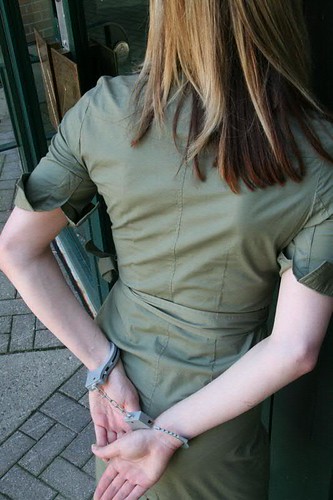
Far more popular (and predictably so) is this picture of me wearing cheap plastic handcuffs, which is frequently added to "women being handcuffed" pools like this one (work-safe last I checked, but I guarantee nothing for the future).
Otherwise, besides a terrible picture of me posing with a teacup dog, it's little surprise that pictures of me wearing boots often turn up in searches. Those whose photo collections contain a suspicious number of boot-shots (again, think before you click) seem particularly happy about this "broken boot" picture.

My point? I guess I think that human sexuality is a wonderfully diverse thing, and it's lots of fun that I can pull a "double-fetish" now and then without ever even trying (though when Vanilla set up the handcuff shot she wisely predicted it would be popular).
But those days are over! Thanks to the quick and widespread content-sharing capabilities of the internet, you can immediately find an extensive group which caters to your every whim and need.
It is my personal mission in life to fulfill as many of these needs as possible, while still maintaining a shred of decency. For instance, this picture has lead to a flurry of hits from a group devoted to "yellow clothes":
Their mandate is simple: "Yellow clothing. No nudity." And that's exactly what its 71 members get.
Far more popular (and predictably so) is this picture of me wearing cheap plastic handcuffs, which is frequently added to "women being handcuffed" pools like this one (work-safe last I checked, but I guarantee nothing for the future).
Otherwise, besides a terrible picture of me posing with a teacup dog, it's little surprise that pictures of me wearing boots often turn up in searches. Those whose photo collections contain a suspicious number of boot-shots (again, think before you click) seem particularly happy about this "broken boot" picture.
My point? I guess I think that human sexuality is a wonderfully diverse thing, and it's lots of fun that I can pull a "double-fetish" now and then without ever even trying (though when Vanilla set up the handcuff shot she wisely predicted it would be popular).
Tuesday, February 17, 2009
Calling Out the Canned Midnight Special Performers
I'm finally watching the 1980 "Midnight Special" DVD and I'm having a rich experience that I'd never anticipated; in seeing the performances range sequentially from 1973 to 1980, I've gotten a sense of the changes in both music style and performance over that period.
My conclusions are by no means scientific -- each season of "Midnight Special" has been compressed to an hour's worth of performances by a small number of artists -- but I have watched the folk renaissance wane and disappear (Gordon Lightfoot, Janis Ian); the growth of disco out of R&B and funk into an increasingly glittery spectacle (from James Brown to Earth, Wind & Fire to Donna Summer to Amii Stewart); the mainstreaming of hard rock (AC/DC) and punk (Blondie); the slow death of glam into a more watered down style (Nick Gilder); and the sudden appearance of white guys with red suspenders and metallic hats, inflicting their humourless, spastic, disturbingly misogynistic dance routines on big-haired ladies with silver stiletto heels.
So, like, the '80s have arrived.
Most interesting, however, has been the evolution of canned performances, which have become increasingly more common and stylized, apparently paving the way for MTV.
Since I love spotting canned performances -- and since some people seem to never notice this sort of thing -- I present this handy guide for figuring out when your favourite '70s band is faking you out.
Straight Up: Everybody in the band is playing their instruments, the singer is really singing, and nothing significant has been added to the mix. This is obvious because the song doesn't sound exactly like the album, and nothing sounds totally perfect.
As an example, here's Heart playing "Crazy On You." It's all so improvisational, they're all looking at each other to keep the playing tight, the vocals are unprocessed and "real," it doesn't sound like the single, and...well, there's an ENERGY.
If you spot the things listed in the following categories, however, then your favourite band is putting you on.
Embellished: Most of the band is really playing and the singer is really singing, but they're playing along with a backing tape which includes horns, a string section, and/or vocal harmonies.
You can spot this if you hear horns or strings, but there is no horn or string section on stage. Keyboards in the '70s were far from reproducing those sorts of sounds, so a mysterious keyboard player cannot be responsible. You can also spot this if the harmony sounds TOO GOOD, and the people supposedly SINGING the harmony are just the band members.
If the harmony is being sung by dedicated backup singers, however, then there's more chance they're legitimate (but beware when two backup singers suddenly sound like four, and they don't do any apparent improvisation, and they overlap in a way that would be impossible for only two people).
You can also spot this if the drummer is wearing headphones, which means he's listening to the backing tape (or a click track) in order to stay in sync. Otherwise the drums are prerecorded and the drummer is just faking it, in which case he's NOT wearing headphones and he's hitting cymbals that you can't actually hear. When this happens, though, pains have been taken to make the drums at least SOUND live (as opposed to the next example).
Here's a good example: Golden Earring's "Radar Love." The vocals and guitar are certainly real, and the bass might be as well, but the drums, keyboards, horns, and most of the backup vocals are fake. The drummer ALMOST pulls it off but you can see moments where he gets it wrong. It's all most obvious near the end.
Singer Only: The band is not playing their instruments, but the singer is really singing along to a backing tape. You can tell this if the vocals sound a bit rough but the rest of the music sounds exactly like the studio version. Also if the instruments -- especially the drums -- sound double-tracked or otherwise produced in a way that wouldn't work live: particularly thumpy or whizzy, for example.
If the musicians don't seem to be paying any attention to each other when the song changes tempo, chances are they aren't really playing...in a live performance they tend to glance around to make sure they're all switching to the right beat at the right time. This is especially obvious at the end of songs which have those big synchronized "WHAM!" (wait for it...) "WHAM!" (one more time...wait) "WHAM! ... WHAM! WHAM! WHAM-WHAM-WHAMWHAMWHAMWHAAAAM" (waaaaait...) (waaaaait...) (waaaaaaaaait...) "WHAM!" endings.
This brings us to the BIGGEST (and most ridiculous) sign of a canned performance: if a song DOESN'T end with a synchronized "WHAM!" and instead actually FADES OUT, then nobody is playing, and I bet the singer isn't singing either (see below). There's a reason why live songs don't fade out: it's impossible, and even if somebody went through all the trouble to make it happen it would just look stupid.
In some cases they'll dispense with the artifice altogether and just put the singer alone on the stage. This is a dead giveaway. You don't go through the trouble of laboriously soundchecking a band just to hide them behind a curtain (though there appeared to be a trend for disco and R&B singers to sometimes put their bandmates in a dark, obscure area, maybe to make the singing and theatrical dancing more prominent).
Here's ABBA's "Mamma Mia" as an example. The "ABBA sound" was so treated and produced that it could NEVER sound that way live, but you can hear the way their live vocals stand out from the rest of the song. Amusingly, the men AREN'T actually singing.
Milli Vanilli: It's all pre-recorded and the singer is lip-syncing. This sounds EXACTLY like the single version, and the vocals sound far too smooth and "treated" to be live. The singer drastically changes the position and distance of her microphone with absolutely no change in the quality or volume of her vocals. She dances in a way that would otherwise leave her out-of-breath, or at least cause her to "hitch" occasionally. She doesn't improv or say "thanks" at the end.
Here's Olivia Netwon-John's "Magic." That is NOT a live voice, it is far too smooth and echoey, it's been sent through a half-dozen sweetening filters. It also sounds exactly like the single. A slightly more subtle example is Hall & Oates' "Kiss On My List," which again is far too slick and -- ha ha -- fades out at the end.
On "Midnight Special," this spectrum gradually shifted from the "Straight Up" to the "Milli Vanilli" area as the years went by. I wonder if the "studio sound" was getting harder to reproduce on stage, or if expectations were simply changing?
At the same time, the audience went from a huge auditorium full of real people sitting down, to a smaller selection of dancing club "characters" -- including, yes, a shiek -- in a way that seems to represent a shift of attitude...instead of the viewer joining an audience to watch a band perform live, it's become the viewer watching a stable of dancers, with a band in the background as an afterthought...like the viewer is just a dancer listening to the radio. A case of nightclubs and their frenetic, hyped-up subcultures killing the live band, maybe?
I assume the logical next step was "Solid Gold," which (to my memory) was just dancers performing to prerecorded hits without anybody from the band even being there.
And after that? I don't know. Any thoughts?
My conclusions are by no means scientific -- each season of "Midnight Special" has been compressed to an hour's worth of performances by a small number of artists -- but I have watched the folk renaissance wane and disappear (Gordon Lightfoot, Janis Ian); the growth of disco out of R&B and funk into an increasingly glittery spectacle (from James Brown to Earth, Wind & Fire to Donna Summer to Amii Stewart); the mainstreaming of hard rock (AC/DC) and punk (Blondie); the slow death of glam into a more watered down style (Nick Gilder); and the sudden appearance of white guys with red suspenders and metallic hats, inflicting their humourless, spastic, disturbingly misogynistic dance routines on big-haired ladies with silver stiletto heels.
So, like, the '80s have arrived.
Most interesting, however, has been the evolution of canned performances, which have become increasingly more common and stylized, apparently paving the way for MTV.
Since I love spotting canned performances -- and since some people seem to never notice this sort of thing -- I present this handy guide for figuring out when your favourite '70s band is faking you out.
THE CANNED PERFORMANCE SPECTRUM
Straight Up: Everybody in the band is playing their instruments, the singer is really singing, and nothing significant has been added to the mix. This is obvious because the song doesn't sound exactly like the album, and nothing sounds totally perfect.
As an example, here's Heart playing "Crazy On You." It's all so improvisational, they're all looking at each other to keep the playing tight, the vocals are unprocessed and "real," it doesn't sound like the single, and...well, there's an ENERGY.
If you spot the things listed in the following categories, however, then your favourite band is putting you on.
Embellished: Most of the band is really playing and the singer is really singing, but they're playing along with a backing tape which includes horns, a string section, and/or vocal harmonies.
You can spot this if you hear horns or strings, but there is no horn or string section on stage. Keyboards in the '70s were far from reproducing those sorts of sounds, so a mysterious keyboard player cannot be responsible. You can also spot this if the harmony sounds TOO GOOD, and the people supposedly SINGING the harmony are just the band members.
If the harmony is being sung by dedicated backup singers, however, then there's more chance they're legitimate (but beware when two backup singers suddenly sound like four, and they don't do any apparent improvisation, and they overlap in a way that would be impossible for only two people).
You can also spot this if the drummer is wearing headphones, which means he's listening to the backing tape (or a click track) in order to stay in sync. Otherwise the drums are prerecorded and the drummer is just faking it, in which case he's NOT wearing headphones and he's hitting cymbals that you can't actually hear. When this happens, though, pains have been taken to make the drums at least SOUND live (as opposed to the next example).
Here's a good example: Golden Earring's "Radar Love." The vocals and guitar are certainly real, and the bass might be as well, but the drums, keyboards, horns, and most of the backup vocals are fake. The drummer ALMOST pulls it off but you can see moments where he gets it wrong. It's all most obvious near the end.
Singer Only: The band is not playing their instruments, but the singer is really singing along to a backing tape. You can tell this if the vocals sound a bit rough but the rest of the music sounds exactly like the studio version. Also if the instruments -- especially the drums -- sound double-tracked or otherwise produced in a way that wouldn't work live: particularly thumpy or whizzy, for example.
If the musicians don't seem to be paying any attention to each other when the song changes tempo, chances are they aren't really playing...in a live performance they tend to glance around to make sure they're all switching to the right beat at the right time. This is especially obvious at the end of songs which have those big synchronized "WHAM!" (wait for it...) "WHAM!" (one more time...wait) "WHAM! ... WHAM! WHAM! WHAM-WHAM-WHAMWHAMWHAMWHAAAAM" (waaaaait...) (waaaaait...) (waaaaaaaaait...) "WHAM!" endings.
This brings us to the BIGGEST (and most ridiculous) sign of a canned performance: if a song DOESN'T end with a synchronized "WHAM!" and instead actually FADES OUT, then nobody is playing, and I bet the singer isn't singing either (see below). There's a reason why live songs don't fade out: it's impossible, and even if somebody went through all the trouble to make it happen it would just look stupid.
In some cases they'll dispense with the artifice altogether and just put the singer alone on the stage. This is a dead giveaway. You don't go through the trouble of laboriously soundchecking a band just to hide them behind a curtain (though there appeared to be a trend for disco and R&B singers to sometimes put their bandmates in a dark, obscure area, maybe to make the singing and theatrical dancing more prominent).
Here's ABBA's "Mamma Mia" as an example. The "ABBA sound" was so treated and produced that it could NEVER sound that way live, but you can hear the way their live vocals stand out from the rest of the song. Amusingly, the men AREN'T actually singing.
Milli Vanilli: It's all pre-recorded and the singer is lip-syncing. This sounds EXACTLY like the single version, and the vocals sound far too smooth and "treated" to be live. The singer drastically changes the position and distance of her microphone with absolutely no change in the quality or volume of her vocals. She dances in a way that would otherwise leave her out-of-breath, or at least cause her to "hitch" occasionally. She doesn't improv or say "thanks" at the end.
Here's Olivia Netwon-John's "Magic." That is NOT a live voice, it is far too smooth and echoey, it's been sent through a half-dozen sweetening filters. It also sounds exactly like the single. A slightly more subtle example is Hall & Oates' "Kiss On My List," which again is far too slick and -- ha ha -- fades out at the end.
...
On "Midnight Special," this spectrum gradually shifted from the "Straight Up" to the "Milli Vanilli" area as the years went by. I wonder if the "studio sound" was getting harder to reproduce on stage, or if expectations were simply changing?
At the same time, the audience went from a huge auditorium full of real people sitting down, to a smaller selection of dancing club "characters" -- including, yes, a shiek -- in a way that seems to represent a shift of attitude...instead of the viewer joining an audience to watch a band perform live, it's become the viewer watching a stable of dancers, with a band in the background as an afterthought...like the viewer is just a dancer listening to the radio. A case of nightclubs and their frenetic, hyped-up subcultures killing the live band, maybe?
I assume the logical next step was "Solid Gold," which (to my memory) was just dancers performing to prerecorded hits without anybody from the band even being there.
And after that? I don't know. Any thoughts?
Subscribe to:
Posts (Atom)