Wednesday, October 31, 2007

iTunes Word Search: "Ghost"

Boo, and Happy Hallowe'en! I'm hoping that no children come to weasel candy out of me; I've lived in controlled-access buildings or student slums for so long that I don't know if they'll come to this area or not, let alone to my grotty little side door, and I didn't want to buy a lot of candy and have it sit around, so...

While wearing my Hallowe'en costume at work (pictures soon) I tried to find a good iTunes Word Search theme. I couldn't think of a good word to represent "Nobody Ever Recognizes My Costume" (other than maybe "darn"), but I DID hit on a good Hallowe'en-ish word that generated results: "Ghost!"
  1. City Ghosts (The Legendary Pink Dots)
  2. Farm Show Ghost (Joey Wright)
  3. Ghost (Headcase)
  4. Ghost (The Legendary Pink Dots)
  5. Ghost in the Gaps (Electroluminescent)
  6. Ghost of a Texas Ladies' Man (Concrete Blonde)
  7. The Ghost of Liberace (Sparks)
  8. Ghost Pirates (P:Ano)
  9. Ghost Talk (Cabaret Voltaire)
  10. Ghost Train Out (The Vincent Black Shadow)
  11. Ghost World (Aimee Mann)
  12. Ghost Writer (Daniel Ash)
  13. Ghosts of Unborn Children (The Legendary Pink Dots)
  14. Our Kitten Sees Ghosts (Califone)
  15. There's a Ghost in My House (The Fall)
  16. Walking the Ghost (James)
Themes? Lost & forlorn, otherworldly, different, spooky, and remnant.

Tuesday, October 30, 2007

The Barthathon: "The Tidewater Tales"


"Sabbatical" was the “twin” of "The Tidewater Tales" (1987). This isn't unusual, since all of Barth’s books have been twinned, but these two were closer than all the others before them. The situations, settings, time-frames, and issues were almost identical. Was that a cop-out? After Barth wrote “Sabbatical” as a sort of post-Letters cost-recoup for his publishers (as he mentioned in “The Friday Book”), did he then say “to hell with it,” throw away his unimpeachable literary integrity, and publish the same old book a second time, greatly expanded?

I thought so at first. Suffering from a certain Barth-fatigue -- I've been reading ONLY his books since July, remember -- I limped through the first hundred pages with an unhealthy skepticism, sustained only by my memory of loving the book the last time I read it (in 1994, my first Barth novel). As Sabbatical was about a couple in crisis, sailing around the Chesapeake bay to resolve the worries of childbirth, adulthood, mortality, story-craft, family, and world affairs…well, “Tidewater Tales” brought us Peter and Katherine. A couple in crisis. Sailing around the Chesapeake. Trying to resolve those exact same worries. Again.

To make matters worse, the couple – typical witty, in-love, sexually open-minded Barth-style adults – discovered installments of a “Sex Education” television play, which they proceeded to read to the reader…and which was, in a word, dippy.

Barth got miffed when a journalist said that the poem in “Sabbatical” was dippy – that is, sort of bad and flakey – to which Barth replied that the poem was written by characters who were not poets, so of COURSE it wasn’t very good. Since “Sex Education” was not written by a well-heeled playwright, it was also bad and flakey...but unlike the "Sabbatical" poem it was also quite long and integral to the "Tidewater Tales" plot. And while “Tidewater Tales” was, among other things, about people striving to hone their writing and storytelling skills, “Sex Education” was SO dippy that it’s bound to annoy many readers, especially if they’ve previously read his short story “Night Sea Journey," of which this is sort of a goofy, poorly-conceived sequel.

But there’s a funny thing about Barth: his best books tend to contain annoying elements...which are later consciously redeemed. As you approach the end of the book you realize that the bad stuff is – as Barth’s characters would put it – dramaturgically required. In the same way that a character must be bad before she can ultimately achieve redemption, so do the Barthian elements need to be bad before they can become good.

And when they’re good…oh, man.

You see, “Tidewater Tales” reached a point – after all the C.I.A. dribble and family conflicts and dippy stories – when the tone CHANGED. Things began to come together and reveal themselves as far more complex and rich than I'd ever imagined. Tangential issues became prominent and – most amazingly – INEVITABLE.

When all the characters finally anchored behind ordinary point, amidst the warm summer night parties of hundreds of other boats, and when they all gathered together for the first time after having revealed their histories and problems and personal quirks during the preceeding bulk of the book…the story revved up. The clouds gathered. The final, long stretches of storytelling -- punctuated by the sudden and tragic storms of grief, anger, loss, anguish, yearning -- brought everything and everybody together, and IT WORKED. I celebrated with the fictional characters. The book was redeemed, its several points exquisitely made, the end.

And yes, I cried at the conclusion of “Sex Education,” I admit it. And I’ll also say, as part of this “redemption” theme, that there are very good (“dramaturgically relevant”) reasons why “Sabbatical” was so similar to “Tidewater Tales.” They are linked in a way that is nothing short of brilliant. Long live Barth, and his characters, and his tales!

Having said that, however, I have a personal message for Mr. Barth himself: lay off Sheherazade, will you? I understand that you have an outright obsession with the character – and that’s fine – but have you ever noticed that OTHER PEOPLE don’t share your enthusiasm? It’s one thing for one or two of your characters to reveal themselves as long-time fans of "1001 Arabian Nights," but when EVERY literate character in "The Tidewater Tales" turned out to gushingly consider her to be the end-all be-all of literary creation, your enthusiasm went beyond “barely-in-control” and into “outright masturbation.” When I realized that I’d have to sit through a 20-page analysis of her menstrual cycle (as ALREADY explored by you in “The Friday Book”), I decided it was time for you to enter Sheherazade detox.

So stop it. Please. I have more of your books to get through and I don't want to deal with Sheherazade again.

“The Tidewater Tales” did inspire me, once upon a time, to read “The Odyssey,” “Don Quixote,” and the first half of “1001 Arabian Nights." You don’t need to read them before tackling this particular book – because unlike “Chimera,” Barth gives an excellent gloss here for those uninitiated – but the characters of Ted, Diana, Donald Quicksoat and – errr – Sheherazade are much richer if you’ve read their respective books.

And that recurring theme about "the key to the treasure is the treasure?" I suspect this is something that Barth reinterprets from time to time, because now it's specifically about WORDS: Stories often feature magic words, which are the keys to fabulous treasures; but the treasures, as represented in fiction, are also words themselves ("a mountain of jewels," for instance), so the key (magic words) to the treasure is also the treasure itself. So there.

If you can explain his new mantra to me ("what you've done is what you'll do"), I'll give you a cookie.

The traditional list of traditional John Barth themes (not including those necessarily pulled over from the plot of "Sabbatical"): anthropomorphized egg and sperm, water messages, keys, Bloodsworth Island, Huckleberry Finn, "once upon a time \ there was a story that began...", the war of 1812, the myth of the wandering hero, 1001 Arabian Nights, The Odyssey, Don Quixote, twins (both babies and doppelgangers), impotence, and leeway in categorization.

Ruth Miller, Sweet-Smelling Scheherazade

I'll have more to say about Scheherazade in a day or two -- once I've finished "Tidewater Tales" -- but for now here's a modern-day, totally sniffable incarnation: Ruth Miller, writing a nested frame-tale for Odorono Deodorant in the May 12, 1928 New Yorker:
Women constantly ask me how they can be free from the danger of underarm odor and ruinous stains on dresses.

I can answer no better than by telling what women who use Odorono regularly tell me.

"My doctor told me about Odorono first years ago; it's marvelous, I use it all the time."

Another, "One day my dress shield slipped and I ruined a new dress. A friend told me about Odorono and now I don't bother with anything else. I use it often enough to keep the underarm dry all the time."

A business woman says, "Perspiration odor turns men in an office against a woman quicker than anything else and Odorono is the only way I know to keep dainty through the strain of a long busy office day!"

"It makes me feel so much more exquisite, and self-confident," says one woman. "I use Odorono twice a week and never have a particle of moisture under the arm."
Four better tales have never been told! I bet Ruth Miller kept her husband awake every night, telling him stories about smelly women in office buildings, always breaking off at dawn before he got a good whiff of her armpits. Notice that there are THREE levels of story here: Ruth Miller says that a lady told her that her friend/doctor told her... She finishes by saying that "women of breeding" use over four million bottles of Odorono.

Before you ask who Ruth Miller was, I have no idea. I guess shilling for a deodorant company didn't bring lasting fame.

Sunday, October 28, 2007

Gukanjima, Another Place You're Not Allowed to Visit


One of the seven wonders of forbidden exploration is the island of Gukanjima, which was abandoned suddenly in 1974 and has remained virtually untouched since, except by the elements. Wind, rain, and rot have given the place an apocalyptic beauty, most famously captured by photographer Saiga Yuji here.

Happy Birthday! Happy Birthday! Happy...err...Hallowe'en!

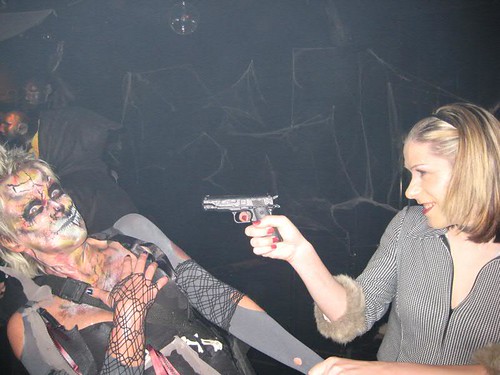
Gotcha, '80s Zombie Girl!
I'm typing like a gimp because I actually managed to bruise a finger on somebody's can of gray hairspray. I might look like a fearless zombie killer in this picture but I'm actually a pussycat with sensitive skin.

First off, a few pictures from Hallowe'en at Club Abstract. As much fun as it was, I really must relocate MY birthday night because I don't think Hallowe'en is budging. There are too many people out and about and the lines for the bathrooms are too long; I literally left early because I didn't want to cross my legs for half an hour. But the girl dressed as Marie Antoinette was one of my favourites, as was Jodi Brown (above), who actually does my hair.

Besides all that, here's the surprise I've been dropping hints about: an extremely rushed and way-too-sober "mini drag show" recorded just before I left the apartment:


I'm still experimenting with so many elements in this process -- lighting, location, camera settings, frame rates, codecs, conversion, editing -- so I can only say that they'll get better. I hope. In this case the show is DEFINITELY stolen by Zsa Zsa, who decided to sit in and watch me make a fool out of myself.

My birthday present to myself was a new digital camera, a tiny little thing with a million settings. During my experiments I have digitized some old Canadiana off of quarter-century-old videotapes, and I've turned up some real gems (with more to come).

By far the brightest, most sparkly gem is this footage from "As You Like It," a mid-'80s Rogers community cable program starring Wilf and Donna, consummate Mennonites. Every week they'd take telephone requests, and EVERYBODY wanted to hear them do this signature tune. Wilf and Donna are a real treat and I'm proud to bring their brilliance to the world.

Friday, October 26, 2007

The Evolving Human/Feline Morning Ritual

When the alarm goes off, Zsa Zsa is already waiting at my bedside, sitting down and staring at me. If I get up, she will run to the top of the stairs in anticipation of being fed; otherwise she will alternate between “yowling” and “running away/coming back” behaviour until I finally get up.

Next, when I leave the bedroom to go into the bathroom, Zsa Zsa is waiting at the top of the stairs. When I subsequently walk out of the bathroom, she runs excitedly down the stairs with what can only be described as a “prance” or a “trot.”

Downstairs, in the kitchen, she meows until I put fresh food and water in her dishes. She sniffs the dishes to make sure all is well, then walks into the living room without actually eating anything, as though all along she just wanted to be reassured that I wouldn’t FORGET to feed her this morning.

With my own breakfast prepared I walk past her and go upstairs into the computer room. I sit and eat my breakfast while reading The New Yorker. At some point she joins me and sits at a respectful distance, snooping around and keeping an eye on me. She is feigning nonchalance.

When my spoon hits the bottom of the bowl, she begins to approach. Sometimes she meows, but not usually. I put the bowl on the floor and tilt it so the last spoonful of sweet milk is puddled up, and she gingerly tests its quality before lapping it up. This is her second favourite time of the morning.

I return to the bathroom and bedroom to groom and dress. Meanwhile Zsa Zsa descends the stairs again, this time in a calm and leisurely way. She is preparing herself for the Morning Petting Ritual.

At last ready to leave, I turn off the upstairs lights and go down into the living room. As soon as I turn the corner and enter the room, Zsa Zsa collapses onto the carpet and lets out an outrageous squeak, the sound of a meow expelled by a forcible flop to the floor. I have to put my stuff down and get onto the carpet to pet her as she kicks her feet wildly, rolling, squeaking, occasionally drooling. If I pat her bum she gets REALLY excited. Needless to say this is the morning's REAL highlight for her.

After a few minutes I stand up, and that’s her cue to stop being cute. We both go into the kitchen, where I put on my shoes and whatever outerwear is necessary. She wanders to her food dish and begins to eat, though sometimes she’ll politely request a treat, which I’ll refuse unless she opens the cupboard and gets the treats out herself, which she occasionally does.

When I’m walking out the door she’ll stand in the middle of the kitchen and watch me. I’ll say “bye!” and she’ll just stare. I never know if she’s sad to see me go or if she’s planning a huge cat party once I’m gone.

Thursday, October 25, 2007

iTunes Word Search: "Sex"

With all that talk about sex and me puking -- and all the interesting points you readers have made in the comments -- I had to consult my iPod and find out what SHE thinks about sex in general.
  1. All You Ever Think About is Sex (Sparks)
  2. Am I Sexy? (Lords of Acid)
  3. Are You Read for the Sex Girls? (Gleaming Spires)
  4. Deep Sexy Space (Lords of Acid)
  5. Do You Think I'm Sexy? (Revolting Cocks)
  6. Feels Like Sex (Geri Halliwell)
  7. Generation Sex (The Divine Comedy)
  8. Goddess of Sexxx (Goddess of Destruction)
  9. I Want Your Sex (George Michaels)
  10. Leathersex (My Life with the Thrill Kill Kult)
  11. My Exclusive Sex Club (Drywall)
  12. Prison Sex (Tool)
  13. Rough Sex (Lords of Acid)
  14. Savage Sexteen (My Life with the Thrill Kill Kult)
  15. Sex (The Pipettes)
  16. Sex (I'm A...) (Berlin)
  17. Sex Bomb (Lords of Acid)
  18. Sex Dwarf (Soft Cell)
  19. Sex Nerve (Adrian Belew)
  20. Sex Object (Kraftwerk)
  21. Sex on the Flag (K.M.F.D.M.)
  22. Sex Whip (My Life with the Thrill Kill Kult)
  23. Sexual Revolution (Roger Waters)
  24. Sexy M.F. (Prince)
  25. Sexy M.M. (Whale)
  26. Sexy Rhino (Adrian Belew)
  27. Sexy Sadie (The Beatles)
  28. Tired of Sex (Moroboshi Industries)
  29. Too Much Sex, Not Enough Affection (Timbuk 3)
  30. You Sexy Thing (Hot Chocolate)
So the themes are generally about actual sexiness (in either a serious or a campy way), political observations about sex & gender, poking fun at kinkiness, and then the lone case of Tool.

Scoring a Ticket

In 1920s New York, you were an absolute NOBODY unless you could score theatre tickets. Opening nights were all the rage, and even though writers for The New Yorker consistently make fun of the people who go to opening nights -- portraying them as brash and obnoxious social climbers or star-gawkers -- those writers seem to go to an awful lot of opening nights themselves.

It was difficult to get tickets because, quite often, "speculators" (who we now call "scalpers") would buy huge numbers of opening night tickets and then re-sell them at a profit.

Curiously, theatre owners had a sort of clout that they don't have today, and they took the position that only THEIR box office should be allowed to sell tickets, and anybody else who did was breaking the law. After some legal wrangling around 1925 it seems the theatre owners lost that privelege, and though police were prosecuting the speculators they couldn't quite keep it under control.

Then came the "Theatre Service" companies, which were basically regulated scalpers. They operated out of actual stores and sold their tickets at only a modest markup.

The Bascom theatre service advertises consistently in The New Yorker, usually featuring the same selection of cartoons, with slightly re-written captions. This particular cartoon always makes me happy; that woman looks SO angry, and she actually resembles my cat in her worst moods. All she needs is a pair of ears lying flat back.
--And the movies hurt my eyes and you said we'd go to any play I picked and you have no business saying there aren't any seats left until you've gone to Bascom--
The gist of these advertisements are always not so much that people will suffer if they don't get tickets to a play, but that people will suffer embarrassment for not knowing that Bascom exists, which is a strange approach to take...but probably effective for the guy who was being pressured at the last minute to find a theatre service with tickets to a particular show.

Wednesday, October 24, 2007

National Velvet and the Muffy Online Heelprint

I was obsessed by the Canadian band "National Velvet." I loved them to death. I recorded every interview and little bitty scrap I could onto VHS tapes that I still (happily) have with me today.

Long after they'd faded from the Canadian music scene, somebody started up an online National Velvet fanclub. I was unable to visit their one-off reunion concert, but I DID manage to contribute to the group by recording a "National Velvet Care Package"...a VHS collection of videos, interviews, and other oddities that I sent to five (or maybe four) people. One of them had promised to record the videos onto a DVD and send it back to me, which (as is so often the case) never happened. Oh well.

Why do I mention this now? Because I was just doing my annual YouTube check of National Velvet videos, and suddenly there are four of them online...all from the VHS I sent out! There's something strange and sort of exciting about this, seeing something that I put together appear elsewhere as though I had nothing to do with it. It means the videos are getting around. It means that people still like the band. I admit that I don't like the fact that I'm not credited for compiling these rarities, but I'm still glad that they're "out there."

So here's "Change My Mind," probably my favourite National Velvet song. Maria Del Mar kicks butt (as always). At the time I remember that there were two contenders for "coolest Canadian female vocalist." When Margo Timmins (from Cowboy Junkies) won, us fans were outraged. But Margo was pretty cool too.


UPDATE: It actually appears that these videos WEREN'T digitized from my original "care package." The guy just taped the same Much Music spotlight that I did, many years ago.

Saturday, October 20, 2007

I Am Here in Oolite

No, I haven't mysteriously vanished. I'm afraid that my mind has been grabbed by the iron fist of Oolite, and for the moment I can't escape.

I've always been fascinated by space travel in its most mundane sense: getting from here to there. I just can't grasp the distances between planets, let alone solar systems, let alone GALAXIES. It amazes me that it's all unexplored, in the way that people must have been amazed by (and attracted to) "darkest Africa" and the poles, before we found out it was all pretty much normal, just harder to get to.

So give me a game where I can explore a "universe," and I'm happy. Make it a game where the travel is mind-numbingly dull -- watching your destination approach over half an hour while your fellow ships travel around you -- and I'm THRILLED. Give me the ability to ADD to the universe with custom MODs, and I widow my blog (and my cat) so I can study the modding language and create mysterious ghost ships and space-age Voyageurs.

As if this wasn't enough, Oolite's universe is also procedurally generated, a process that has obsessed my slightly-autistic mind since I was a child, watching computer-landscapes blossom from the union of a number seed and an algorithm. You needed to think about these things when you had only 64K to play with.

Once I've explored its boundaries and gotten frustrated by the scripting languages, I'll probably put aside Oolite and never play it again. I already can't believe that I'm willing to sit for ages watching a planet get slightly bigger, while my cat cries "love me!" from the floor. But sometimes I get hooked on these things, and since this weekend was a scheduled "no-bar" interval this is the perfect time to indulge myself.

So I'm sorry that the blog hasn't been updated. I'll make it up to you soon with ANOTHER new obsession, which is a surprise and infinitely more social.